Monday, May 16, 2011

MUNDI ROMANI

MUNDI ROMANI
THE WORLD THROUGH ROMA EYES

Television Series

A Romedia Foundation © Production
I encourage everyone to visit mundi romani.  There are many wonderful videos of the tv program.
These are the same people who made I AM ROMA WOMAN-----Morgan

-----------------------------------------------------------------------------------------------------

http://www.mundiromani.com/

There are at least 12 million Roma scattered throughout the world.

Despite being Europe’s largest minority, the Roma have been voiceless for centuries.

As a people and as a culture, the Roma have been and continue to be misrepresented, mythologized, stereotyped, scapegoated and persecuted.

With thorough investigation and through admiration for the untold stories, Mundi Romani, a documentary series co-produced by Duna Television Hungary and the Romedia Foundation, explores the amazing world of the Roma from Kosovo to Spain through Romania, France, Macedonia or Israel.

There is an incredibly rich culture we never got to know, a whole world of traditions and values, another viewpoint from which we are not used to see our world, its troubles as well as its beauty. Because throughout time and throughout the world, the Roma have never been heard.

Roma film maker Katalin Barsony travels the world to give a voice to the voiceless through a vision and celebration of a people who have always been misunderstood and kept out of the public eye. With the determined refusal of being defined by the fear and suspiscion of others, she takes us on a colorful and always surprising journey around the world as it looks like through the eyes of the Roma.

Sunday, May 15, 2011

ROMANI IN EUROPE

Roma as Active Citizens: Closing the Gap between Political Elites and Local Communities

By Catherine Messina Pajic,
Deputy director of programs for the Central and Eastern Europe region at National Democratic Institute (NDI)

09/05/2011 -

Victimized by violence, segregated in settlements, deprived of education, healthcare, and jobs, and routinely denied their rights as citizens, Roma are also excluded from the political arena where they could attempt to address these problems. As a result, many Roma no longer seek to participate in politics or civic life at any level, persuaded that it is a losing proposition. This reticence is seen by some in the majority population, as a simple, and false, solution to ―the Roma problem:‖ if they are ignored, eventually they will go away.

However, the impact of the Roma’s disaffection is immense. Countries with large Roma populations, primarily in Central and Eastern Europe, court social instability and enormous economic costs as these impoverished communities grow larger and more distant from the state apparatus. Last year’s expulsion by France of Bulgarian and Romanian Roma migrants suggests that even established European democracies - and the European Union as a whole—are ill-prepared to grapple with this growing population that is living not as part of the state but parallel to it. These events have shown that until Roma, as a community, become active, participatory citizens who can use the political process to resolve issues, secure resources and obtain services, democracy in Europe will remain an unfulfilled promise.

Despite myriad assistance strategies to improve their legal and material conditions, little effort has been made to position Roma to help their own cause through political participation. Roma must organize their communities to gain effective political representation and hold governments accountable. It is in everyone’s interest for Roma to amass this power to solve their problems peacefully before violence and extremism take hold.

Active Citizenship: What is it?

Citizenship implies a relationship between people and their government that includes a set of rights and responsibilities, including the right to participate in decisions that affect the public welfare. Citizens are essential to democratic governance. They give life and meaning to democratic principles and to the institutions designed to create accountability and set limits on government power. Without the active involvement of citizens, government power can be abused to benefit only a narrow segment of society.

Citizen activism is a democratic right and responsibility that can constructively influence state behavior and socioeconomic development. To exercise this right, Roma must first understand and embrace the concept of citizenship. They also need knowledge to make decisions about policy choices, along with the skills to voice their concerns, act collectively and hold public officials accountable.

Civil society is a vehicle, like political parties, through which Roma can aggregate their interests, voice their preferences and exercise the power necessary to affect change. Civil society can amplify citizen voices and bridge the divide between Roma and the state. Civil society organizations come in various shapes and sizes, from large, urban-based nongovernmental organizations (NGOs) to small, community-based social groups. Among these are organizations that interact extensively with citizens and, more often the case with Roma, those with very limited interaction, even though they may claim to be working on their behalf. Political decisions on complex socioeconomic challenges.

CATHERINE PAJIC

Link: http://www.ndi.org/files/Catherine-Pajic-Roma-Chapter.pdf

Saturday, May 14, 2011

LETY

CONTROVERSY AT CZECH ROMA HOLOCAUST SITE


The following is a short and good report aired last night on NPR KUOW 2 Seattle.

Correspondents report
http://mediacenter.dw-world.de/english/audio/#!/137086/Controversy_at_Czech_Roma_Holocaust_site


Report by Rob Cameron in Prague.
Played on NPR   KUOW 2   91.8FM Seattle WA
5/13/2011

DEERFIELD ILLINOIS

I debated for quite awhile whether to post this racist article.  I chose to because it shows how we are portrayed in the United States media.  I read new articles like this every day.  It is disheartening.
"Gypsies, tramps and thieves......."
 Happily the one comment which appeared with the article is the positve one which follows.  Please be sure to read the comment.
MORGAN
--------------------------------------------------------------------------------------------------------

FROM DEERFIELD PATCH

http://deerfield.patch.com/articles/gypsy-scams-hit-deerfield#c
Gypsy Scam Artists Hit Deerfield

Police say elderly man scammed out of $2,200.

Article and Photo By Natalie Kaplan
May 13 2O11

Police are warning local residents to watch out for scam artists possibly targeting the Deerfield community.

According to Commander of Investigations Walter Trillhaase an elderly Deerfield man was conned out of thousands of dollars earlier this week.

“They’re bad people picking on the older folks,” Trillhaase explained.

A local victim told authorities he was approached in front of his home by a group of individuals who offered to clean the markings off his garage floor for $22. However, when the work was completed the suspects demanded $2,200. Authorities say the resident felt pressured into writing the check, which was quickly cashed by the thieves.

Officials tell Patch this is the second incident they’ve dealt with in the past 12 months and that some of the scam artists cruise communities like Deerfield searching for elderly people outside their homes.

Police say spring and summer are active times for scams that commonly include home repair fraud and ruse entry burglary.

“It’s not something we can sit and wait for,” Trillhaase said which is why Deerfield Police have been handing out flyers to alert residents about the situation.

In that flyer it explains that "the appearance of a Gypsy can be generally described as medium to dark complexioned Caucasian, who are often mistaken as Hispanic."

Patrols are also being increased in residential neighborhoods.

They are encouraging residents not to allow unknown individuals perform work on their residences before checking that person’s reputation. Authorities also warn residents not to allow anyone into their homes or let them roam their property.

The flyer also notes that there are other transient criminals who do similar types of cons and this information about Gypsies only deals with self-proclaimed Gypsies who have elected to live the criminal lifestyle.

--------------------------------------------
THE FOLLOWING IS A GREAT COMMENT
Heather Ureche

11:24am on Saturday, May 14, 2011

I assume that the Police or someone in some authority has established that these people are in fact what you have decribed as Gypsies? I wonder if it was really vital to the report to sugsest the ethnicity of the person concered? Also had they been from let us say the Jewish communitty would the headline then have read "Jewish" Scams Hit Deerfield ? or "Asian" Scams Hit Deerfield ? or "Mexican" Scams Hit Deerfield? No I thought not; why then Gypsy? They may or may not have be Gypsies. Whoever they are what they are doing is not right or acceptable however by using the word Gypsy in this way is both racist and provocative it is alsp un fair on the many thousands of good hardworking and law abiding Romani people in the USA who already face daily prejudice and stigmatisation simply on the basis of their racial origin, reports such as this one just compounds the problem by reinforcing stereotypes.

Heather Ureche. UK.

HELSINKI

FROM HELSINGIN SANOMAT


INTERNATIONAL EDITION - METRO

MORE ROMA ARRIVING IN HELSINKI FROM BULGARIA


Day centre opens in Sörnäinen

http://www.hs.fi/english/article/More+Roma+arriving+in+Helsinki+from+Bulgaria/1135266123469


PHOTO BY SAMI KERO HS
Georgi Georgiev (Centre, below), the father of three children, is surfing the internet, hoping to find a van that they can use as a place to sleep. Behind him Goran Zherkov (left) and Lezko Georgiev evaluate the car that they have found.


The coffee machine is making its second batch of the day, and the washing machine is finishing a new load.

The Roma day centre in Pääskylänrinne in Sörnäinen opened its doors this week, and word has spread rapidly. New Roma have been arriving in Finland recently, this time mainly from Bulgaria.

“Last Thursday 80 people came here for a shower, says Marjatta Vesalainen, one of the centre’s two full-time employees.

The former service centre for the homeless is open every weekday for four hours. During that time, the East Europeans can wash their laundry, take showers, and deal with business on the internet.

Others just drink coffee and wait for their mobile phones to charge on the floor.

The smell of after shave from Lidl is in the air. Someone cuts his hair in the toilet, and the drain gets clogged.

The centre, which goes by the name Hirundo (Latin for “swallow”) is run by the Deaconess Institute together with the City of Helsinki. Vesalainen says that a few disgruntled city residents have shown up at the centre to complain.

Previously Roma from Eastern Europe have washed at the Kaalo day centre for Finnish Roma.

This spring there has been a surge of Roma from Bulgaria.

“They are not the poorest of the Roma”, says Ralitsa Dimitrova, a Bulgarian substitute worker of the Deaconess Institute.

She was hired to the day centre when it was noticed that it was not enough to have an employee who speaks Romanian.

Dimitrova says that the poorest Roma cannot afford to travel to other parts of Europe.

Men gathered around a computer ask the photographer present to help them find a car sale website. One bright blue van is on sale in Laukaa, which is too far away.

Cars are needed both for travel through the Baltic countries, and for sleeping. Most of the Bulgarian Roma sleep in parking areas in the centre of Helsinki.

City ordinances forbid camping without permission. Groups of Roma drying their laundry have been driven away from Kaisaniemi Park, the Kyläsaari recycling centre, and the Pitäjänmäki district.

The camp where Georgi Georgiev and his group have lived has also been dismantled. Most recently he slept in a car near the Satama social centre, which has Romanian Roma living in its yard.

“We are discriminated against. The police only chase away the Bulgarians, but not the Romanians”, Georgiev says.

The Roma from the two countries tend to shun each other. They compete for the same deposit bottles and coins.

The Bulgarians shake their heads angrily when they are asked about begging and the Romanians.

“Pullo, pullo” (“bottle, bottle”) they say in Finnish. Deposit bottles are their source of income.

Jarmo Räihä, a leading official at the Helsinki Social Services department, believes that there are fewer Romanians among the Roma than before. He believes that word has spread that begging here is not very profitable.

Maria Calin and her husband have tried to earn money by playing the accordion on Helsinki streets and in Metro tunnels. They have not been very successful, and now they are asking for assistance from the City of Helsinki to get back home.

But first they need to find the Social Services building in Kallio. Earlier in the week someone gave the couple directions to the nearby headquarters of the Social Democratic Party.

Friday, May 13, 2011

CITIZENS OR NOT

FROM EUROPEAN POLICIES INITIATIVE

Link:

http://www.euronews.net/2011/05/13/are-roma-european-citizens-like-any-others/


Are Roma European citizens like any others?


12/05/2011 -

 “My name is Vincent, and my question concerns what happened to the Roma one year ago. Is it normal they were removed from France when they are in the Schengen space and are Europeans? I find it odd to shift them from country to country like that, and I want to know: why?”

Claudia Charles of the Immigrant Rights Group GISTI explains:

“We can say it’s not normal to be able to expel them, rather than relocate them, expel the Roma.”

“The Roma people from Romania and Bulgaria are European citizens like those of the other 25 nationalities which make up the European Union today. But this is distinct from the Schengen space, which is not quite the same thing.”

This means that the 25 Schengen agreement countries are not all EU members, and not all the EU states are in Schengen, just 22 of them out of the 27 are in this internal borders free area. Romania and Bulgaria are not yet part of it.

The non-EU Schengen countries are Iceland, Norway and Switzerland. The EU countries outside Schengen are the UK, Ireland, Cyprus, Romania and Bulgaria.

Claudia Charles continues:

“Everything that France did last year and is still doing this year borders on illegality, because while it is true that an EU citizen has certain obligations in order to reside legally in an EU state other than his own, we also know that the Roma are the target of discrimination, in seeking employment, access to housing and access to education.”

“These questions do not only concern the Roma. They are grabbing headlines today, since, as everyone knows, France and Italy have asked jointly that the European Commission and the Council modify the conditions of free circulation within the Schengen space.”

“We’ll see how things unfold, we’ll see what the European Commission’s proposes about the conditions for crossing the EU’s internal borders. It is always necessary to highlight that, unfortunately, with the arrival of Tunisian migrants the principle of free movement is being scrutinised in a way that not only hampers migrants but could also hamper free circulation for EU citizens within the European space.”

Thursday, May 12, 2011

LETY

FROM ROMEA.CZ

http://www.romea.cz/english/index.php?id=detail&detail=2007_2427

Roma victims of Nazism to be commemorated at Lety this Friday


Lety u Písku, 11.5.2011 10:13, (ROMEA)

Since 1997, the 13th of May has been the day on which some citizens of the Czech Republic and other countries travel to Lety by Písek to remember the almost 400 Roma victims of the former "Gypsy camp" there as well as all Roma people murdered by Nazism. As every year, those who are unable to travel to Lety on their own can take advantage of the free bus which is annually organized to depart from Prague by Čeněk Růžička of the Committee for the Redress of the Roma Holocaust (Výbor pro odškodnění romského holocaustu).

With two days to go until the ceremony, there are 20 places left on the bus. Those interested in reserving seats can contact Mr Růžička (603 247 617, ruzicka.vporh@seznam.cz). The bus will leave Prague at 9:45 AM and will be parked as usual in front of the main gate of the Florenc bus station, under the highway overpass, near the final bus stop for municipal bus No. 133. The bus will have a sign reading "Lety" on it. The return to Prague is planned for between 15:30 and 15:00. Mr Ruben Pellar will accompany the bus.

On this occasion, the surviving victims of the camp and relatives of those imprisoned there, figures of Czech cultural, political and religious life, representatives of various diplomatic corps to the Czech Republic, people from nonprofit organizations, youth and media come together to pay their respects. Last year the event was attended by as many as 500 people, the largest number to date. How many citizens and former or current representatives of the government and state institutions, as well as how many visitors from abroad will attend on Friday remains a question. Support for this year's commemoration has been expressed by Czech Green Party chair. The party's website is calling on party members to attend.

The program of the ceremony, held with the support of the Foundation for Holocaust Victims (Nadační fond obětem holocaustu), will start at the burial ground on the site of the former concentration camp for Roma people at 12:00. There will be a march to the burial ground and poet Emil Cina will recite one of his works. After Mr Růžička's introduction, wreaths will be laid at the monument "To the victims of the Gypsy Camp at Lety 1942 -1943“. Before 13:00, deacon Vojtěch Vágai will perform a religious service. After speeches are made by various guests, the official part of the ceremony will end around 14:00 with a tour of the new memorial renovations which were opened not quite on year ago. As is traditional, those interested will continue on to the nearby village of Mirovice, where wreaths will be laid at the memorial to the children who perished in the camp.

translated by Gwendolyn Albert

ROMEA

Wednesday, May 11, 2011

RROMANI BAXT

usaid.com
Wednesday, May 11, 2011 9:30 AM

"Roma Luck" on the outskirts of Tirana

Tirana, Albania,
11/05/2011 -

 "A – B – C – D – E – F – G..." shouts a colorful little classroom full of six-year-olds. "Who knows how to count that on their fingers?" asks the 50-year-old teacher with the pageboy haircut. A boy in a red sweater jumps up and waves his hand so the teacher will call on him. She nods. "Nine!" the boy shouts. There is a tense silence in the classroom, broken by the teacher responding "Bravo!"

It is 8 AM on a Friday at the kindergarten run by the Albanian Roma association Rromani Baxt (Roma Luck) in a Tirana suburb, and "grade zero" undergoes an hour of instruction every day here. Behind the large glass entrance door the colorful children's cabinets, pasted over with figures their owners have cut out of magazines, cannot be missed. The walls are decorated with murals depicting scenes from the television serials Rebecca, Kit and Balu, or Teletubbies. The endless scraping of wooden chairs and the children's laughter can be heard through the closed doors. In one of the two classrooms, children between the ages of three and five and learning to paint flowers.

All kinds of children

Almost 20 children are crowded into a room and are listening closely to the instructions of their Albanian teacher. A Roma instructor interprets into Romanes for those who do not understand Albanian. The situation eloquently illustrates the basis of Rromani Baxt's education programs. Most of the Roma children living in the suburb of Allias do not speak Albanian. To a significant extent this reduces their chances for a successful start in education. According to the association's director, Pellumb Furtuna, most Roma children's educational careers end in failure. Insufficient progress is not the only reason - abuse and ridicule of Roma pupils by Albanian ones is also a factor. Bullied Roma children easily shut down with respect to those around them and drop out of school after a short while.

With the aid of Albanian and Roma pedagogues, the Roma nursery school is doing its best to prepare its charges linguistically for their journey to the classroom. "Often when the children come to us they know almost no Albanian. When they leave here, they are able to express themselves nicely in Albanian, they know the basics of reading and writing. That increases their chances of making it to higher education," director Furtuna, whom everyone in the suburb calls "Gimi", explains.

The nursery school is attended not only by Roma children, but also by the children of Egyptians (see note below) and several Albanian children, whom Gimi says are being sent to the nursery school by enlightened parents interested in breaking down stereotypes and raising their children multiculturally. It is not unusual to see non-Roma children reciting verses in Romanes at Rromani Baxt.

Albanian language for greater opportunity

While the three-to-five-year-olds are learning about the colors and shapes of flowers, regular instruction is taking place in the classroom next door. Since its founding in 1992, kindergarten education in the so-called "Year Zero" has been promoted in addition to the Roma nursery school. There the children master the basics of counting, reading and writing before entering mainstream primary education. As in the nursery school, instructors at the kindergarten emphasize perfecting the children's Albanian language skills. When transferring to the majority-population school, they will then be able to build upon their knowledge of Albanian.

Rromani Baxt continues to provide assistance to those children who succeed in mainstream primary school (according to Gimi, most of those who attend the organization's program are successful). Association staff regularly visit the elementary schools and keep tabs on the children's progress. They also visit the children at home and explain to their parents the importance of their children completing the highest possible educational level.

"It is customary for the families here to remove their children, girls in particular, from elementary school in the fourth or fifth grade. The children then work on the streets as either beggars or street vendors. The family needs their income to survive," says Anita, a social worker at Rromani Baxt. The organization does its best to convince parents that these days education may be the only way their children can eventually find good jobs and ascend the social ladder.

Blessed mashed potatoes with brown gravy

The school desks are now slowly starting to be cluttered with painted plastic plates containing mashed potatoes and brown gravy with a bit of meat. It is noon and the preschool program activities are over for today. Before the children are sent home they fill their stomachs with a hot lunch, provided by the organization for free.

Meal money and tuition costs are two more reasons Roma parents do not send their children to majority-population schools in Albania, as they simply do not have the money. Rromani Baxt also financially assists Roma parents interested in enrolling their children at public nursery schools, covering most of the expenses related to their attendance.

"These programs have really delivered results for us. Today we already have several students at academic high schools, and several have continued on to college during the almost 20 years we have been in existence," Furtuna estimates.

Recycling for education

Because the options for financing Rromani Baxt's programs are very limited (it is regularly supported by the Roma Education Fund), Furtuna decided to set up a waste sorting business to maintain the economic side of the association's activities in future. "The Albanian government has only given us financial support for some small, restricted projects. That's why we had to come up with a way to continue to operate. We cannot rely only on financing from foreign foundations and social funds," he explains.

The association has concluded an agreement with several bureaucracies, embassies and supermarkets in Tirana to deliver their paper and plastic waste to it sorting facility. Young boys regularly retrieve the waste from these affiliated institutions and four permanent employees sort and bale the waste. The paper and plastic is then taken in a rented truck by the staff to factories for further processing. Rromani Baxt is then paid for the recycling. However, for the time being the association still does not have enough money to buy its own truck, which would make it easier to bring the waste to the sorting facility and then transport it to the factories. The association is paying no small amount of money to rent a truck and therefore can't increase its output by hiring more unemployed people.

Rusila! Rusila! – Lorena! Lorena!

"Lo-re-na! Lo-re-na! Lo-re-na! Lo-re-na!" we hear from a silver minivan plowing through the dusty streets of Allias. The 10 children on board have decided to say goodbye to their friend Lorena. It's 3 PM. This is the time when the public nursery school's program ends, and 10 children from Rromani Baxt are attending that school as part of a pilot program. The organization placed them at the public nursery school to test the impacts of integrated schooling on their charges. Most of the children attending the nursery school are Albanian.

Gimi has arrived with his minivan as usual in front of the school to pick up the nine Roma girls and one boy and drive them home. The children are crawling out from beneath blue comforters to change back into their holiday clothes. The teacher gives them each a sweet bun and they get into the dusty Mercedes. "Who do we let off now? Whose time is up?" Gimi asks the laughing children. They are quiet for a moment and then start to surreptitiously look over their fellow passengers. It's decided! "Ru-si-la! Ru-si-la!" Gimi soon joins the children in their shouting and in a few moments we are parked in front of Rusila's home, where the driver hands her over to her parents. A few words are exchanged about what happened at the nursery school today. The parents offer Gimi coffee, but he has to refuse. He must deliver the children to their homes. He gets in the care once again and the next child is chosen - it's Klaudia.

How long will Roma Luck last?

Even though at first glance it might seem like it would not be so easy for Rromani Baxt to be closed down thanks to its reliable, strong, and very well-liked preschool education programs, the association has had many unpleasant skirmishes. The latent racism of Albanian authorities and institutions is a particular problem. When the authorities turn their backs on the organization's activities, the group is forced to rely on international aid.

"I don't understand it," Gimi says sadly. "I believe we are doing good work. Our results testify to that. People like us, Roma people recognize us. We have been in operation for 20 years. Despite that, here in Albania only the projects of non-Roma organizations are supported. They organize all kinds of conferences and seminars that are not of any particular significance. We can show concrete results, but nobody listens to us here," he ends frustratedly.

There is no doubt that Rromani Baxt has positively influenced both Roma and non-Roma society in the area. The appreciative looks and smiles from Roma parents, as well as the many friendly greetings given to Gimi and the staff of the preschool center on the streets of Allias, are a testament to that. However, it is a question whether the organization will succeed despite the drying-up of resources from international funds or whether it will succeed in its courageous project of creating a central waste-sorting facility. There is no doubt that if its activities were to stop it would be an enormous loss for dozens of families.

Note on Egyptians: In addition to Roma people, a minority known as the "Egyptians or "Jevgs" lives in Albania. The Albanian majority society considers these people, together with the Roma, to be so-called "Gypsies" and often makes no distinction between these groups, calling them both "dora e zeze" ("black hands"), while other minorities living in Albania are referred to as "dora e bardhe" ("white hands"). The origin of the Egyptians is not completely clear. One theory espouses the opinion that these are descendants of Egyptians who came to Albanian in the 3rd or 4th century, or that they are the descendants of Egyptian slaves imported there during the Ottoman Empire (1299-1923). Another theory (recognized by most experts) is that the Jevgs are assimilated Roma who abandoned their language, traditions and the traveling way of life earlier than other Roma groups did. The Jevgs speak only Albanian. Unlike the majority population of Albania, which views them as the same, Jevgs and Roma do their best to maintain the differences between them. However, both groups face similar problems, particularly social exclusion in the areas of access to basic infrastructure, education and employment. The living standard of Egyptians is somewhat higher than that of Roma people. We will also see a similar distinction among groups of Roma in Kosovo, where there are three groups, Ashkali, Egyptians, and Roma people.

Lukáš Houdek, Zdenka Kainarová
Translated by Gwendolyn Albert

Link: http://www.romea.cz/english/index.php?id=detail&detail=2007_2428

Tuesday, May 10, 2011

FROM THE GAYUGANDA BLOG.

http://gayuganda.blogspot.com/

The Anti-Homosexuality Bill, 2009: Political Gimmick, and Diversion.


Or, the so-called Bahati Bill.

"Well, as I was sleeping, on this self enforced hiatus, the wheels of parliament were moving.

Now, the anti-Homosexuality Bill is at present being discussed in the parliament of Uganda. Just today, as I write. Yes, today, Friday the 6th of May 2011. Committee hearings are reportedly going ahead.

Now, remember that this is the lame duck session of parliament. And, remember that it is supposed to end soon, on 11 May 2011.

And, that on 12 May is the coronation of the King. Uh, do not think that am using my words without real care.

Why is the Anti-Homosexuality Bill being discussed today in parliament? And as a matter of urgency? Pure and simple. DIVERSION.

Less than a week ago, the opposition parties started a 'walk-to-work' peaceful protest. The government responded with over whelming violence. Currently, as I write, the major opposition leader is in neighbouring Kenya, for medical attention for injuries he received during one of his 4 arrests. They sprayed tear gas and pepper direct into his face, after breaking down his car windows. And, this was in full view of the press.

The next day, riots paralysed the country. It was after the video of that arrest was shown on TV. Ugandans, the citizens of the country were appalled. They came out on strike. And, the government responded with overwhelming violence again. So bad that the spectre of Idi Amin Dada, famous dictator and life president of Uganda was raised.

So, the country is in a ferment. With the coronation to happen in just a few days time. So, the Anti-Homosexuality Bill is beind discussed... and ready to be passed.

So, it is a DIVERSION. The government needs a heady diversion for the country. For the outraged citizens of Uganda.

So, and this is very important, what is the government trying to do?

In actual fact, that diversion is not going to work. Because the citizens of Uganda are simply more concerned about the rising prices of food, and the deteriorating human rights situation. Their homophobia is a reflex which the government wants to use. But, it is not likely to work.

Oh, I am gay. I am Ugandan. I know what am talking about.

But, the international community is going to be appalled. The US allies are going to be astonished. And, there are going to be calls for this bill to be shelved....

Hey, so, what should you do?

People, I am a gay man, who is Ugandan. I can be killed because of being gay in Uganda. But, I can also be killed because of the general abuse of human rights in the country.

I REQUEST, AND BEG OF YOU, OUR ALLIES, NOT TO BE FOOLED.

That is very important.

If you want to condemn the Anti-Homosexuality Bill, please CONDEMN in the strongest terms possible, the general state of Human rights in Uganda.

Oh, the Bill will be passed in parliament. Have no doubt about that.

But, remember that this is time for the GAY MOVEMENT around the world to make COMMON CAUSE with the average citizen of Uganda to decry the abuse of human rights of ALL UGANDANS.

Do not separate the two issues. Mention both in the same sentence, in the same breath.

Tell this to your leaders in the community, to your leaders in your country. To your leaders in your parliament, and to your leaders nationally and internationaly.

LGBTI rights are HUMAN Rights. They are not divisible. They are not above others, they are not distinct from the others.

Make common cause in demanding the cessation of abuse of rights of Ugandans, including LGBTI ugandans, by the Government of Uganda.

Let the message go out, simple, clear, unambiguous.

LGBTI rights are human rights. And, we are concerned about the rights of ALL Ugandans, including LGBTI Ugandans.

That is the message. That is the statement. That is what we need to say.

And, yes, go ahead and talk. Tell everyone. Because, again, we cannot fight this in Uganda. The diversion will occur if you are outraged, and forget that not only kuchus in Uganda are at risk. Talk, make the bold and angry statements. Make them about Ugandans in general. And also Ugandan kuchus.

And, thanks for your help."

gug (Gay Uganda)


http://gayuganda.blogspot.com/

------------------------------------------------------------------------------------------------------------


FORWARDED MESSAGE FROM ALL OUT

"Dear Friend,

I just signed a petition demanding that Ugandan President Museveni veto the "Kill The Gays" bill should it be passed in Parliament.

We just learned the “kill the gays” bill - a death sentence for LGBT people in Uganda - could come up for a vote in the next 24 hours if we don’t act now.

Conservative leaders are trying hard to push the bill forward before the millions like us who oppose it have a chance to speak out. If we can create a massive international outcry, theres a chance to stop this bill from becoming law.

This hateful bill appears to be a political diversion, a way to distract from the legitimate grievances of pro-democracy activists, who have been beaten, teargassed, jailed, and even killed in recent weeks.

There are only days left to make sure your voice is heard. Will you join me in demanding the Ugandan President Musevini veto the "Kill The Gays" bill should it be passed in Parliament? Sign and share this urgent petition:"

http://www.allout.org/uganda

SERBIA

FROM EMG.RS

http://www.emg.rs/en/news/serbia/154621.html

Dacic calls on Roma not to seek asylum in EU countries


First Deputy Prime Minister and Minister of the Interior Ivica Dacic called late yesterday on the citizens belonging to Roma national minority not to seek asylum in Western Europe countries because this can endanger state and national interests of Serbia.

Upon his visit to a Roma settlement in Zemun, where he attended the celebration of Saint Mark Patron Saint’s Day in the house of Estef Ramadanovic, Dacic told the Roma citizens that Serbia is their country and that all citizens in Serbia, regardless of nationality, should have the same rights and be equal.

I urge Roma not to go to Europe and seek asylum because they will be returned for sure, but that we do everything in our power to make their life better, Dacic underlined.

He underlined that for Serbia all its citizens are absolutely equal, and said that solution to one of the problems of Roma will be amendments to the Law on domicile, which will enable them to get documents although they have no address.

We want to work on inclusion of Roma and we want to tell them that seeking asylum is definitely not the way to solve problems, the First Deputy Prime Minister and Minister of the Interior concluded.

Monday, May 9, 2011

THE DOMARI SOCIETY OF GYPSIES IN JERUSALEM

This is an excellent video made by the Domari Society of Gypsies in Jerusalem

http://youtu.be/ce7s0jGKfLM

For more information please visit their website

http://www.wix.com/domarisociety/domari-society-website

Sunday, May 8, 2011

WHO ARE ROMA

IAN HANCOCK
FROM  YOURHOUSTONNEWS.COM.


‘Who are Roma?’ topic of May Divas Salon

 Thursday, May 5, 2011 10:02 am

Divas World presents “Who are the Roma?,” a Divas Salon performance at 8 p.m. May 17, 2011 at Duncan Recital Hall at Rice University.

“Who are the Roma?” will explore the history of the Roma (or Romani) people — commonly though inaccurately known as “Gypsies” — who have been in the Americas since the late 1400s. Their roots are in India, but a long history of oppression has spread them to various corners of the globe. This same history has led to a rich tradition of music and art about survival and triumph.

Musical selections will feature traditional Roma music and Dvorak Gypsy Songs.

Romani scholar Ian Hancock will join host and moderator David Eagleman for an evening that will blend music and discussion while considering the facts and dispelling the myths about the Romani people.

Hancock is director of the Program of Romani Studies and the Romani Archives and Documentation Center at The University of Texas at Austin, where he has been a professor of English, linguistics and Asian studies since 1972. He has represented the Romani people at the United Nations and served as a member of the U.S. Holocaust Memorial Council under President Bill Clinton.

Notable Romani’s of the world include Charlie Chaplin, Bob Hoskins, Adam Ant, Ronnie Wood, Olympic boxing medalist Serafim Todorov, and Nobel Prize winning scientist August Krogh.

Musical selections will feature traditional Roma music and Dvorak Gypsy Songs.

The Divas Salon Series is a uniquely modern expression of the 19th century European tradition of classical music programming. Music and intellectual thought are integrated by combining musical performance, a short lecture, and an interactive conversation with the audience and artists.

“Who are the Roma?” will be recorded for national broadcast on public radio, and the audience will experience an exciting behind-the-scenes look at the making of a public radio show.

“Who are the Roma?” is free and open to the public. Seating is limited and is available on a first-come, first-served basis. Doors open at 7:30 p.m.; the performance begins at 8:00 p.m. Duncan Recital Hall is located in the Alice Pratt Brown Hall at Rice University.

For information, contact Divas World at 713-524-2854 or visit http://www.divasworld.org/.

I AM ROMA WOMAN

FROM ROMEDIA

http://www.romawoman.org/

“I’m a Roma Woman”


A Romedia Foundation © Multi-Media Campaign

http://www.romawoman.org/

The campaign website exhorts Roma women to speak out and be the change

“If my daughter wants to be a president, then she will be the first Roma woman president.” - says Violeta Naydenova, one of the young Romani activists featuring in the Romedia Foundation’s project, the www.romawoman.org website.

Starting International Women’s Day 2011, videos, films, photos, news, life stories and experiences are shared by an estimated six-seven million Romani women worldwide through the campaign website created by the Romedia Foundation, a Budapest-based Roma advocacy organization.

“Our culture is still unknown to most, rumors and prejudices about who we are abound and make up a wall through which we are trying to break through to show, one story by one story, that we are individuals, mothers, daughters, wives. My grand-mother believed that she could make it through and it is now for me to make sure everyone knows that others made it through, too.”– Katalin Barsony, managing director of the Romedia Foundation.

With this campaign the Romedia Foundation, a Budapest-based Roma advocacy organization, aims to create a vision of the future for Romani women which gives space for self-representation, draws strength from both Romani and the majority cultures and stresses the opportunities offered by social activism in terms of both self-fulfillment and community empowerment.

SPEAK OUT! BE THE CHANGE!

Visit http://www.romawoman.org/

Supported by the Open Society Foundations and the Decade of Roma Inclusion 2005-2015

BULGARIA

FROM NOINVITE.COM

Bulgarian NGOs Rise Against Anti-Roma Protest


Society
May 7, 2011, Saturday

http://www.novinite.com/view_news.php?id=128010

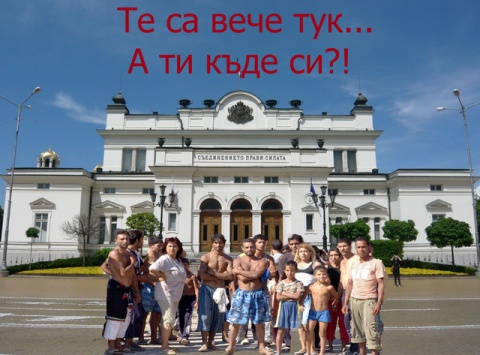
"They are already here...Where are you" reads this poster posted in the Bulgarian Nationalist Forum. It shows Roma individuals and in the background - the building of the Parliament in dowtown Sofia.

Bulgarian NGOs have expressed their concerns over mass anti-Roma protests in the country organized in the Internet for May 8.

The organizations, including the People Against Racism, the Roma Solidarity Foundation from the town of Petrich, the Interethnic Initiative for Human Rights and others, have demanded that the Bulgarian authorities should abolish the events planned.

The scheduled "National Protest against the Roma-zation of Bulgaria" is organized in Internet forums and Facebook by different nationalist groups. Some 14 000 people have stated on Facebook that they will attend it.

Among the nationalists' demands are Roma families to be allowed to have only one child and that Roma people be stripped of their "privileges'". Citizens are invited to protest in front of "all municipality buildings" across the country.

Bulgaria's ombudsman, Konstantin Penchev, has already contacted the Chief Prosecutor with regard to the potential protest. On Thursday, the Sofia municipality said no official request has been received for a protest, the Dnevnik daily repots.

Saturday, May 7, 2011

EAST LAWN CEMETERY SACRAMENTO CALIFORNIA

FROM VALLEY COMMUNITY NEWSPAPER.

Gypsies a significant ethnic group at East Sac’s East Lawn Cemetery


By ELLEN COCHRANE
http://www.valcomnews.com/?p=4024

There is a Gypsy curse known by an unlucky few as powerful and relentless.

“May you wander over the face of the earth forever, never sleep twice in the same bed, never drink water twice from the same well and never cross the same river twice in a year.”

Fortunately, for Alex Adams (1861-1917), the Gypsy king, the curse held no sway during his life. This ruler lies in peace in East Sacramento’s East Lawn Cemetery. He is untroubled by malicious words or the evil eye. He is peacefully surrounded by scores of his relatives and ancestors, including his queen, Mary (1877-1934).

Unfortunately, though, there was one bump in the road. Early last century, his tomb was robbed. A large marble slab was pried off the tomb and valuables were taken. Police at the time believe the thieves were after items typically buried with gypsy leaders. His Queen Mary, had opened a purse and threw coins into the casket adding to the treasures.

East Lawn opened in 1904. The park has interred Sacramento notables and thousands of plain folk. The park occupies 40 acres in the heart of East Sacramento’s Fabulous Forties.

East Lawn has always welcomed all ethnicities, religions and cultural groups and the Gypsy presence is active and growing. Most Gypsies today are Christian, many are Orthodox, a nod to their East European roots.

Wives, cousins, husbands, adopted children, uncles and aunts – the family trees of the East Lawn Gypsies are intertwined and nearly impossible for an outsider to figure out.

The term “royalty” is applied by the Gypsies on merit more than heredity. Feats of familial support and service can lead to being called a chieftain, or king.

One thing is clear: the Gypsies embrace love during life and honor their dead in grand style, whether a king or peasant.

Gypsies are not shy and bury their dead with pomp and flourish. Funerals include feasting, music, laughter, crying and storytelling. Markers and mausoleums are substantial.

In the mid-20th century, one of the California Gypsy kings, Dushon John, was interred at East Lawn with style. The New York Times reported, “As the copper-lined coffin, blanketed in gardenias, carnations and sweet peas was lowered, token offerings of coins were deposited. Mr. John was buried also with such personal effects as a toothbrush, a mirror and hair oil for his journey into the future…a twelve piece band played dirges and the gypsies toasted with soft drinks and beer.”

Even today you can see a relic from the past. If you peek in the Millen Pavolovich mausoleum, another king, you will see a fashionable 1930s hat encased in a glass box. It was his favorite hat.

On a cool brisk day before Easter, this writer walked through the park admiring the granite work and trees.

A caravan of late model cars began a slow drive from the front gate.

Well-dressed, middle aged people stepped out of the vehicles carrying bouquets of yellow roses, tulips, Easter baskets, spring motif balloons, bags of McDonald’s hamburgers and hot apple pies, wineglasses, beers, soda and cups of coffee.

The banquet was laid at the tomb of John and Lulie Uwnawich in the heart of the park’s gypsy region. But only after the tomb was tidied and a mantel of aluminum foil was laid as a tablecloth.

These Gypsies came to celebrate the lives of their loved-ones.

A feast fit for a Gypsy king and his queen, laid out by Gypsy family members recently at East Lawn Cemetery. Gypsies are known for visiting the graves of loved ones in grand style. / Valley Community Newspapers photo, Ellen Cochrane

Mary (no last name given) was happy to permit a photograph of the feast laid at the grave.

“We come to remember,” she said. “I don’t know if the next generation will do this, but we still celebrate the old ways.”

There was no grief in the faces of the family. Smiles and conversation filled the air. The group was happy to celebrate the memory of the dead.

Craig Peterson, park manager at East Lawn, admires the Gypsies’ practices.

“They celebrate lives,” he said. “The park is considering the removal of part of a roadway to accommodate more family members. For the most part, they are buried in a common area.”

When asked if this writer could take their picture, the Gypsies replied, “No, honey, we don’t do that…No please, that’s not our way, not here.”

Who the Gypsies are is often confused.

The Gypsy people are believed to have emigrated from Northern India more than 1,000 years ago.

They are not of European heritage and are not Romanian. However, the Diaspora did lead most of the group to Eastern Europe, with pockets of the population in France, Spain and England.

Intermarriage with locals and exposure to different cultures influenced the Gypsies over time, but they remain a distinct group with their own practices, language and unique view of the world.

Historically, Gypsies were heavily persecuted, at times with deadly consequences. They were often outside of the mainstream of society, living a nomadic life and relying on horsemanship skills, craftsmanship and fortune telling for income.

This independent living drew the suspicions of locals and the Gypsies were frequently attacked and used as scapegoats.

And some of the Gypsies did engage in criminal behavior.

During World War II, Gypsies suffered further attacks from Adolf Hitler and the Nazi racial extermination policies. Tens of thousands of gypsies perished in concentration camps, primarily in Auschwitz.

Emigration to the US began in earnest during the Eastern European waves of the early 1900s, primarily from south-eastern Europe.

On that spring day in East Sacramento, however, there was no fortune telling, no bangles nor jewels. There was love and honor, a proud people remembering their dead.

Friday, May 6, 2011

A LITTLE BACKGROUND

FROM INTERNATIONAL BUSINESS TIMES

http://www.ibtimes.com/articles/140038/20110501/roma-gypsies-india-balkans.htm
The Roma people (or "Gypsies" in the common vernacular) have come under the media spotlight again following reports that extreme right-wing vigilantes in Hungary have made threats on the local Roma population, forcing them to flee to safety elsewhere, with help from the Red Cross.

But who are these Romani people who have lived in Europe for centuries and seem to always exist on the fringes of society; and who have inspired much literature, music, legends and misconceptions?

For one thing, the English word "gypsy" is a corruption of "Egyptian," based on the mistaken assumption that the Roma came from Egypt.

Roma, who have endured extreme poverty, slavery, prejudice, discrimination, social exclusion and even mass murder (culminating in extermination by Nazi Germany) throughout their long history in Europe and elsewhere, are widely believed to have migrated westward from northern India in the early Middle Ages.

As such, the Roma have left evidence of their settlements across the Old World from South Asia, through the Middle East and into Europe.

There are currently at least 12-million Roma in Europe (some estimates run as high as 20-million or even more). They are concentrated in Eastern Europe and the Balkans -- in many of these countries Roma comprise the largest ethnic minority.

In a book about the European Roma, "Bury Me Standing," the author Isabel Fonseca wrote: "Gypsies have no home, and, perhaps uniquely among peoples, they have no dream of a homeland."

She also described the Roma as living "outside history."

SPAIN
The Roma in Spain, who number perhaps as much as 500,000, are known as "Gitanos", and have become intricately connected to the public perception of Spanish culture, particularly in the southern province of Andalusia.

For example, flamenco music, renowned across the world, is entirely of Roma origin.

Roma have been in Spain since at least 1425 and have been subject to persecution that kept them a repressed class for centuries, although many made a living as entertainers, blacksmiths, horse traders, musicians, dancers and fortune-tellers and street vendors. However, begging and stealing also predominated.

Since the death of General Franco, the Spanish government has undertaken a more sympathetic policy toward the Roma, especially in the areas of education, housing, social welfare and social services.

HUNGARY

Hungary has long been associated with Roma, where they are believed to form about 10 percent of the population. Roma here have come under ethnic attacks in recent years, particularly by right-wing nationalist and paramilitary groups who have blamed them for crime. Some Roma have even been murdered.

Hungarian Roma remain burdened by dire poverty, poor housing, high unemployment and bad education. They also have the highest birth rate in the country.

However, Roma now have some semblance of political representation. In the European elections, 2009, Livia Jaroka became the sole Romani representative of the European parliament from Hungary.

GREECE

Roma have lived in Greece since the late 14th century and now number about 350,000. They are the largest ethnic minority group in the country and are known as “Tsiganes.” According to the Pelekas.com website, "most Greek Roma are indigent, living either as nomads seeking seasonal employment, or in makeshift settlements with no infrastructure whatsoever."

Pelekas adds: "Living in a legal limbo, [Greek] Gypsy populations attempting to settle down have repeatedly faced social prejudice and harassment. In recent years, as land has become more expensive, forced and often illegal evictions of Gypsies from long-standing settlements by order of municipal authorities have become more frequent. "

It is estimated that 80 percent of Greek Gypsies are illiterate.

During the Athens Summer Olympics of 2004, Roma families and encampments were reportedly cleared out and bulldozed, respectively, by Greek authorities, in order to provide space for athletic events (and most likely to remove the poor Gypsies from public view).

ROMANIA

The name of the country of Romania is derived not from the Roma (gypsies), but rather from the Roman Empire.

In any case, Romanian Roma made news last summer when French president Nicolas Sarkozy ordered the deportation of hundreds of them from his country -- in a move that was widely condemned given that Romania is a member of the EU.

There are believed to be more than 2-million Roma in Romania (accounting for almost 10 percent of the nation's population).

While most Roma here are desperately poor, a distinct minority are quite well off, some are even wealthy landowners

BULGARIA

Roma have had a significant presence in Bulgaria for at least 600 years. Although the Socialist government abolished ethnic appellations in the 1970s, prejudice and discrimination against Roma remains firmly in place.

Although the numbers cannot be verified, scholars believe there are probably about 500,000 Roma in Bulgaria, accounting for about 5 percent of the population.

Government efforts to assimilate Roma and force them to abandon their nomadic lifestyle have only been partly successful.

POLAND

Many Roma in Poland were exterminated during the Nazi Holocaust (a tragedy they called the Porajmos). In the late 1980s, many Roma migrated to Germany.

As such, the Roma population is relatively small - estimated at only about 50,000.

However, Roma made a strong impact on Polish culture, poetry and music.

Perhaps the most famous Polish Roma was the poet and singer, Bronisława Wajs, better known as Papusza.

ALBANIA

The Roma of Albania, who have been in the country for at least 600 years, are somewhat different from their brethren in neighboring Balkan nations in the sense that decades of isolation and poverty has left virtually all Albanians poor. Thus, the Roma, in general, are not much worse off than the other Albanians.

Roma in Albania are nominally Muslim and live all across the country. They number about 150,000.
TO SEE THE SLIDE SHOW VISIT

http://www.ibtimes.com/articles/140038/20110501/roma-gypsies-india-balkans_11.htm

MACEDONIA

Macedonia: The Roma - Inside or Outside the Circle?


Posted By Filip Stojanovski

On 2 May 2011 @ 22:27

http://globalvoicesonline.org/2011/05/02/macedonia-the-roma-inside-or-outside-the-circle/

The Roma in the Republic of Macedonia (RM) have political representation, including a Member of Parliament, a Mayor, and a Government Minister.  Their legal and ethnic rights are institutionally protected, and the media do not use ethnic slurs. However, most of the Roma suffer the oppression of poverty, compounded with the consequences of negative stereotyping based on skin color and perpetuation of traditional prejudices by their fellow-citizens.

Srki, a young Roma man from Skopje, wrote on his blog

   The Republic of Macedonia enjoys high reputation because it provides special treatment for the Roma, compared to other Central and Eastern European states. Many researchers and human rights activists who worked in Macedonia claim that the Roma do not suffer open racism and racist violence, open discrimination, etc., the way they do in the rest of Europe.

Macedonia is a multi-ethnic country, and home to a number of ethnic groups, including: Macedonians, Albanians, Turks, Serbs, Bosniaks, Roma and Vlachs. The Constitution of RM and the laws provide protection of the cultural, language and religious rights to all minority entities. The Constitution also recognizes the right to use native (mother) languages within the public education system.

According to the 2002 Census, there are 53,979 Roma in Macedonia, while some Roma NGOs claim there are around 132,000 members of this ethnic group, based on their surveys.* The Roma are the poorest of all minority groups in RM. They live in all cities, usually on the periphery. These suburb represent ghettos [4], inhabited by Roma only under very bad conditions of low-quality housing. Even though the Government and the current [Roma Decade [5]] invested large efforts to redeem the situation, the Roma are still at the lowest social level, with the highest number of illiterate persons and the lowest percentage of employment. The majority of the Roma live in illegally constructed houses and substandard dwellings without the basic infrastructure: without legal connections to water supply and sewage, without access roads, etc. These bad environmental conditions affect the already bad economic situation, and, together with discrimination and marginalization, are the main reasons for limiting the access of the Roma to the educational process. For these reasons, the Roma also have low access to social and health services. In order to truly aid the Roma, leaders must envision long-term actions and priority measures based on improving these conditions.

Many people accept the view that the Roma enjoy a relatively better treatment in Macedonia, when compared to other Balkan and European states. However, the questions remain:

- What does a “relatively better treatment” mean?

- Does the Universal Declaration of Human Rights [6] include terms such as “relatively recognized rights,” “relative protection of a certain right,” and the like?

In conversations with the non-Roma, with my acquaintances, colleagues, associates and intellectuals… I often hear: “You lack nothing, you've got everything here, you make music, dance, you are a joyful people, good for song and dance… Enjoy life and do not push to enter were you do not belong…”

In spite all the research results that show that the Roma live integrated in Macedonia, that they are included in social circles… I still suffocate, from the looks full of prejudice I encounter when I go out in the street, from the stereotypes exposed by public personas, political figures, and regular citizens, from their weird looks and behavior when I sit in a coffee house, in a restaurant or at a disco…

The “magic circles” of discrimination continue to exist…

Over the years, NGOs have reacted to cases of discrimination, such as denial of entry to Roma children in public pools, or police brutality toward the Roma, which usually remain without official closure. Ethnic Macedonian bloggers also tackle this issue from time to time. For instance, in 2009 Bi wrote about a “shameful” protest against building of a center for street children on the premises of a kindergarten in Bitola. In 2010, Global Voices covered the incident involving the use of overwhelming police force in a Roma-majority Skopje suburb of Šuto Orizari (aka Šutka).

* The discrepancy between census results and the “actual” estimated numbers may stem from the cases of people who adopt the identity of a larger, more powerful ethnic group, allegedly due to hope that it would provide them material or other benefits. This affects various ethnic groups, leading to controversies about the “true” identity of portions of the population in various combinations: Roma “turned” into Turks or Albanians, Muslim ethnic Macedonians or Albanians “turned” into Turks, Christian Macedonians “turned” into Bulgarians… On the other hand, representatives of the small ethnic Egyptian community vehemently deny any relation to the more numerous Roma. The state's response on such issues is that all citizens have the right to self-determination in regard to ethnic identity and nobody should influence their choices.

Article printed from Global Voices:

 http://globalvoicesonline.org/

URL to article:
http://globalvoicesonline.org/2011/05/02/macedonia-the-roma-inside-or-outside-the-circle/

SLOVAKIA AND THE CZECH REPUBLIC

FROM ROMEA.CZ

Three Roma families repeatedly attacked in Slovakia over Easter


Gemerská Poloma, Slovakia, 2.5.2011 13:18, (ROMEA)
http://www.romea.cz/english/index.php?id=detail&detail=2007_2398
The village of Gemerská Poloma in the Rožňava district of Slovakia experienced three days of terror against Roma families during the Easter weekend. The families were attacked in their homes by a group of youths whom the victims say were "skinheads". Local activist Stanislav Kučerák reported the incident to the Roma Press Agency (Romská tisková agentura - RPA).

Kučerák said there are about three youths living in the village who are sympathizers of the neo-Nazi movement and that they called on other men from around the district to come to the village. Approximately 40 - 50 men gathered there and attacked the Roma families directly in their homes, destroying everything they could get their hands on, from dishes to furniture to windows, even tearing doors off their hinges. They also beat some of the Roma residents. Small children witnessed all of the violence committed against their families.

The Roma who were assaulted sought help from Mr Kučerák. He called the police and insisted that a patrol arrive as quickly as possible because of the threat not only to health and property, but to the lives of the citizens concerned. Mr Kučerák said two police officers arrived on the scene within five minutes.

"The officers raised their voices to me and asked me questions like, 'Who are you? You seem like a real smart guy...' They were unpleasant to me and did their best to show me that I am nobody. They told the Roma people who had been attacked that they would not guarantee their protection and that the best thing for them to do would be to call a taxi and flee to their relatives. They stayed on the scene for about 20 minutes, taking photos and writing something up. Then they commented that some other body was going to have to handle it anyway and said the Roma families hadn't even had a gate up in front of their homes so that the area in front of the houses was basically free space," explained Kučerák.

Kučerák went on to say that the mayor of Gemerská Poloma's only comment was that the Roma had not been attacked without cause. He recommended them to lock their doors.

"The mayor is said to have reached an agreement with the three people responsible from the village. He wanted to prevent, by all available means, this information from reaching the public through the media," Kučerák said.

Kučerák says the attacks on the Roma families in Gemerská Poloma took place late Friday night and in the early morning hours of Saturday and again late Saturday and in the early morning hours of Sunday during the Easter holiday. He also said a similar attack took place last year in the village. The Roma Press Agency asked the Regional Police in Košice for a statement and will publish it once they receive it.

Roma Press Agency, translated by Gwendolyn Albert

ROMEA

-----------------------------------------------------------------------------------------------------------------
ENAR: Time to say a loud NO to neo-Nazis in the Czech Republic!


Brussels/Prague, 30.4.2011 22:17, (ROMEA)

The European Network against Racism (ENAR) and ENAR Czech Republic are very disturbed by the rise in neo-Nazi demonstrations and events in recent months in the Czech Republic. In advance of the upcoming neo-Nazi demonstration planned for 1 May 2011 in Brno, ENAR is calling on the City of Brno and the Czech Government to take a firm position on right-wing extremism and this blatant incitement to hatred.

Monika Bunžová, second Vice-Chair of ENAR Czech Republic, says: "We are very disturbed by rising right-wing extremism in the Czech Republic. Unfortunately, this is reflection of current societal developments related to the government cuts in the area of social expenditures, which most affect citizens who are already deprived and poor. This incurs dissatisfaction and frustration in society and leads to an increase in sympathy for right-wing extremism and populist ideas for addressing complex social problems. The neo-Nazis point the finger at easy targets like Roma people and the members of other minorities, blaming them for all the problems in our society. When faced with these dangerous, ubiquitous ideas it is very important that all citizens speak up and say a clear NO to neo-Nazi rhetoric.”

The right to assembly is a fundamental human right which should not be denied even when it is used to support ideas with which some might disagree. However, we must point out the fact that the aim of these demonstrations is to incite hatred and to intensify the use of negative stereotypes against people of various ethnicities and other minorities.

ENAR and ENAR Czech Republic are very concerned that local and national institutions usually do not take any action to open, unequivocally condemn these demonstrations. By failing to act, they send the wrong signal, which is that the ideas the neo-Nazis support are acceptable, despite the reality that they in fact represent an enormous threat to the cohesion and endurance of our society. On the contrary, during neo-Nazi marches in many towns there have been reports of evidence of covert support for such marches on the part of representatives of those towns.

ENAR Czech Republic calls on municipalities in the Czech Republic to take a responsible approach to neo-Nazi marches similar to that taken in other European towns. On 1 May, another such march will take place in Brno which has billed itself as "against the invasion of foreign workers and the exodus of our people - work only for Bohemians and Moravians."

In the name of the right to peacefully but strongly express our personal disagreement with hatred and intolerance, ENAR Czech Republic calls on citizens and representatives of nonprofit organizations both from the Czech Republic and from neighboring states to join us and express support through all available means for the rejection of neo-Nazi marches through Czech towns. Extreme-right events are becoming more and more visible, which leads to a greater number of racially motivated crimes against minorities (especially against Roma people) not only in the Czech Republic, but also elsewhere in Europe, such as in Hungary. Extreme-right groups also have a supranational dimension and are doing their best to connect right-wing extremists from various EU Member States.

Information about ENAR: The European Network against Racism (ENAR) is a network of European NGOs fighting against racism in all the EU Member States and represents more than 700 NGOs from the entire EU. The creation of the network was the primary result of 1997 as the European Year of the Fight against Racism. ENAR's aim is to fight against anti-Semitism, Islamophobia, racism, and xenophobia and to promote the equal treatment of EU citizens and those from third countries. The members of ENAR in the Czech Republic are the following organizations: Czech Helsinki Committee, IQ Roma servis, Romodrom, Life Together (Vzájemné soužití), Český západ, Slovo 21, Zvůle§práva, the Association for Integration and Migration (Sdružení pro integraci a migraci).

Press release of European Network against Racism, translated by Gwendolyn Albert

ROMEA

Thursday, May 5, 2011

DOSTA

ENOUGH IS ENOUGH

BY MARKO D. KNUDSEN
Enough is enough, like we Roma say “Dosta”.

Its time that a Roma gets appointed as European Commissioner for Roma Issues

After decades of exclusion, ignorance, denegation and Holocaust denial, we need to work together on a demand that is first realistic and secondly will bring a positive change for Roma.

That’s why I’m asking you, Roma or Non-Roma, Private Person or NGO, Gouvernmental Institutions or International Organization, to support this initative for change.

It is time to raise the voice in the European Union about the centuries of oppression, decades of Holocaust denial, Antitziganistic Behavior and exclusion on all public levels towards the Roma.

Our demands:

- a Europan Commissioner on Roma Issues

- must be a Roma

- must be appointed by a Internet Voting of the Roma people

- Working Fields of the Commissioner on Roma Issues:

1. Implementation of the European Roma Rights Charter of the ERTF

2. Implementation of the Action Plan on Roma by the OSCE/ODiHR

3. Implementation of the EU Minority protection and the protection of Minority languages

4. Protection of the Human and Civil Rights of the Roma, granted by the Fundamentals of the European Union idea.

Please join this cause and share it with everyone, just if we will be thousands the European Comission will have to deal with us and our demands.

Dewlesa

Marko D. Knudsen

President of the Euuropean Centre for Antitziganism Research
(http://www.ezaf.org/)

Director of the RomNews Network
(http://www.romnews.com/)

TO SIGN THE PETITION PLEASE VISIT

http://www.causes.com/causes/599559-its-time-that-a-roma-gets-appointed-as-european-commissioner-for-roma-issues-de-rom-en/about

www.causes.com/Roma2EC

Wednesday, May 4, 2011

TRAVELLER CHILDREN

FROM CHILDREN AND YOUNG PEOPLE NOW
Traveller children's education slips down list of council priorities

BY LAUREN HIGGS

Wednesday, 04 May 2011

http://www.cypnow.co.uk/News/EmailIt/1067785/2A3A60EBC60D0C5565F6318D7FE04BD2/


Campaigners express concern over public service cuts and measures in the Localism Bill that are likely to have a detrimental effect on the educational opportunities of Gypsy and Traveller children.

Fears are growing that many Traveller children will end up out of school. Image: Tom Campbell

Forced evictions and dwindling support services for Gypsy and Traveller children are obstructing their access to education as a result of cuts to local authority support and measures in the government's Localism Bill, CYP Now has learned.

Anthea Wormington, policy officer at the National Association of Teachers of Travellers, said that Traveller education services are being scaled back or scrapped altogether in many areas.

"Most Traveller education services are experiencing cuts. The picture is changing daily, but it's pretty dire and London has been hit particularly hard," she said.

"Until now, we've had a network of Traveller education services around the country, so if a Traveller family was planning a move we would call up our colleagues in the area where they were moving to and get them to arrange the children's education.

"That won't be possible any more, so I fear that the children just won't end up in school, especially secondary school age children."

Some local authorities are continuing to pay for Traveller education services through their ethnic minority achievement grants, but campaigners are worried that this method of funding is unsustainable.

"That ethnic minority achievement grant is going to go into the dedicated schools grant from next year, so the future doesn't look good," Wormington said.

But a Department for Education spokesman said changes to the funding stream should not impact upon children. "This is not about removing support," he said.

"We have de-ringfenced a number of grants to give heads more flexibility and control over their own budgets because they know their own pupils best.

"And the pupil premium, which targets money at the most disadvantaged pupils, will rise to £2.5bn and will be given directly to heads so they can use it as they deem appropriate."

Gill Brown, spokeswoman for the London Gypsy and Traveller Unit, claimed that plans included in the Localism Bill are also likely to disrupt the education of Gypsy and Traveller children.

This is because the bill includes proposals to revoke official guidance on Gypsy and Traveller sites to allow local areas more control over planning decisions.

Increased local determination, Brown argued, will lead to an increase in forced evictions, such as that which occurred at the Dale Farm site in Essex last month, where more than 80 families were evicted.

"We believe leaving these decisions to local areas will lead to an increase in evictions of Gypsies and Travellers, which in turn has a detrimental effect on children's education," Brown said.

"Regional government offices have also been dismantled. So with the disappearance of regional strategies for Gypsies and Travellers and the erosion of local Traveller education services, the education of more children and young people is under threat.

"When an eviction caused a family to pull their children out of school in the past, the Traveller education services were there to intervene, but now they will not be able to carry out that outreach work."

Cliff Codona, chair of the National Travellers Action Group, warned that Gypsy and Traveller families across the country are in "desperate situations".

"The Traveller education services were always there in the past, but now they are disappearing so things are getting harder and harder," he said. "The money for Traveller education services is going into the ethnic minority achievement pot - and we're at the bottom of that pot."

He claimed that councils are failing to communicate with local Gypsy and Traveller communities. "Local authorities are not engaging with people to let them know what's happening, so Gypsy and Traveller families do not know who to contact for support," he said. "When people have problems, there is no one there for them to go to.

"Things were starting to get better under the last government, but we are one group of people that this government couldn't care less about."

TRAVELLER STATISTICS

18,146 - Gypsy and Traveller caravans in England (on both authorised and unauthorised sites)

Source: Count of Gypsy and Traveller Caravans July 2010, Department for Communities and Local Government

35.5% - Of Travellers of Irish heritage children reached expected level in reading at Key Stage 1 (national average 84.7%)

Source: Department for Education

8.3% - Of Gypsy and Roma children achieved five or more A* to C GCSEs including English and Maths (national average 54.8%)

Source: Department for Education

MAY FOURTH

May 4th 1886
Date of the Haymarket Massacre at a labor demonstration for the 8 hr working day.
See this blog for Sunday 1 May for more information.

May 4th 1970
Ohio National Guardsmen opened fire on students during an anti-Vietnam war protest at Kent State University.  Four students were killed and nine others were wounded.

GERONIMO

FROM NPR

NATIVE AMERICANS OFFENDED BY CODE NAME 'GERONIMO' IN BIN LADEN MISSION

BY MARK MEMMOTT

PHOTO- BEN WITTICK/NATIONAL ARCHIVES/AP

http://www.npr.org/blogs/thetwo-way/2011/05/04/135985017/native-americans-offended-by-codename-geronimo-in-bin-laden-mission?sc=emaf
It's been confirmed, by CIA Director Leon Panetta, that when U.S. commandos reported that they had killed Osama bin Laden, they used the code word "Geronimo."

And to confirm the al-Qaida leader's death, they reportedly said "Geronimo EKIA" (enemy killed in action).

While there's uncertainty about whether Geronimo was a code name for the al-Qaida terrorist or for the whole mission to kill or capture him, the use of that Apache chief's name in any such context has offended Native Americans.

"It is being interpreted as a slap in the face of Native people, a disturbing message that equates an iconic symbol of Native American pride with the most hated evildoer since Adolf Hitler," writes Lise Balk King at Indian Country Today.

"It's insulting and hurtful," Vernon Petago, a member of the Jicarillia Apache Tribe in New Mexico, tells the Minneapolis Star Tribune. "What were they thinking? They applied a respected Apache leader's name to the most despicable terrorist in the world."

The National Congress of American Indians has released a statement from Jefferson Keel, its president, in which he says, in part:

"Our understanding is that bin Laden's actual code name was 'Jackpot' and the operation name was 'Geronimo,' " [But] "to associate a Native warrior with bin Laden is not an accurate reflection of history and it undermines the military service of Native people. It's critical that military leaders and operational standards honor the service of those who protect our freedom."

Keel is a retired Army officer who received two Purple Hearts, a Bronze Star with "V" for valor and the Army Commendation Medal for his service in Vietnam.

Tomorrow, the Senate Indian Affairs Committee will bring up the use of Geronimo's name during a previously scheduled hearing on Native American stereotypes. The committee's staff director, Loretta Tuell, "says it is inappropriate to link Geronimo, whom she calls 'one of the greatest Native American heroes' with one of the most hated enemies of the United States," The Associated Press reports.

As Biography.com says, Geronimo (1829-1909) "led his people's defense of their homeland against the military might of the United States." Indians.org writes that he "was the leader of the last American Indian fighting force formally to capitulate to the United States. Because he fought against such daunting odds and held out the longest, he became the most famous Apache of all. To the pioneers and settlers of Arizona and New Mexico, he was a bloody-handed murderer and this image endured until the second half of this century. To the Apaches, Geronimo embodied the very essence of the Apache values, aggressiveness, courage in the face of difficulty."