IN JERUSALEM, ACTIVIST HOPES TO RESTORE GYPSY PRIDE.
Q & A
Amoun Sleem runs a community center to help Gypsy youths fight poverty and discrimination, which she once faced herself.
April 19, 2013|By Edmund Sanders, Los Angeles Times
FROM THE LOS ANGELES TIMES
http://articles.latimes.com/2013/apr/19/world/la-fg-israel-gypsies-qa-20130420
JERUSALEM — Growing up poor and motherless in the slums of Jerusalem's Old City, Amoun Sleem dropped out of school at age 7 after her teacher repeatedly singled her out as a Gypsy, inspecting her hair for lice in front of the class and calling her "Nawar," a derogatory Arabic term that means "dirty."
On the streets, she learned English by selling postcards to tourists, but soon realized that a life of begging was not for her. At 9, she reentered school and stayed until she got a degree in business administration from Ibrahimi College in Jerusalem.
Now Sleem runs the Domari Society of Gypsies in Jerusalem, a community learning and advocacy center created to preserve the culture of the Dom people, believed to be a branch of the Roma ethnic group — though she prefers the term Gypsies. She hopes to instill pride in today's youths, who are facing the same poverty and discrimination she did.
As many of Jerusalem's approximately 1,000 Gypsies seek to assimilate into Palestinian society because they've been made to feel ashamed of their roots, Sleem's center offers classes in the dying language of Domari, cookbooks of Gypsy recipes, lessons in traditional crafts and after-school tutoring to address the community's dropout rate, which she said is still 30%.
Sleem, who is publishing her autobiography later this year, spoke to the Los Angeles Times about how to end her community's cycle of poverty without losing its identity in the Holy Land, where Gypsies have lived for centuries.
It seems one of the biggest challenges to Gypsy culture in Jerusalem is the shame and self-loathing some Gypsies feel. What happened to Gypsy pride?
A lot of us gave up on our culture because we didn't want people to point or laugh at us. We face discrimination from both Israelis and Palestinians. So in order to fit in, some are ashamed to even speak our language in the streets. Traditionally, Gypsy women love colorful clothing, but now they dress like other Palestinians so they don't stand out. As we mix in with Palestinians, we are losing our identity.
Much of the problem is with ourselves. People look at us as if we are lower. They think we are lazy or beggars. They don't want their children to marry us. It makes us feel that we are not acceptable. And because we don't see any other reality, we start to believe it too.
How do you combat those negatives attitudes, especially when they are instilled at such a young age?
It's very hard to correct. Children learn to be ashamed because of the discrimination they face in schools and in the streets. We provide emotional support and after-school tutoring. We teach them to be proud to be Gypsy. [Recently] some of the girls came into the center to show us their exams and they all got high scores. They were so proud.
The best way is to try to grow inside them a strong belief in themselves. We see some progress. Sometimes I tease them when they are bad and call them "Nawar," and they say back, "No! We are the Dom people."
Gypsies and Jews were both persecuted in the Holocaust. Has that created a bond between the groups?
Most Israelis see us as Palestinians, but sometimes they might respect you a little more than Arabs, probably because this history brings us together. The Jewish people had many of the same problems. No one wanted them in their countries.
But that doesn't turn into help for us. There's not much attention paid to us from the Jewish side. We'd like the government to recognize us as an official minority. We hope that would allow us to get money and support for our culture.
Some of the harshest treatment seems to come from Palestinians.
I connect it to the occupation. They feel they are discriminated against by the Jews, so they look for someone else to discriminate against.
But to be honest, our community is not easy. We don't prove [our worth by making] good livings. You don't see a lot of Gypsy businessmen. There is still a problem with beggars. It's become a bad habit for us. This is the only community center we have.
As an outspoken community leader and a woman, are you seen as a role model?
No, there is still a mentality about women. People think I'm trying to wear the pants or trying to be a man. Being single makes it even worse. Many in our society don't support or believe in women. Yet a lot of the burden is on women, who are expected to beg, raise the children and take care of the house while men sleep and drink coffee. But now you're starting to see more divorce in the community. Women are saying this is not OK anymore.
Which parts of Gypsy culture are most at risk?
The language could disappear here in 20 years. Only older people speak it, though it's more common in Gypsy communities in Gaza Strip and Jordan.
I'm also trying to bring back items like pillows, jewelry-making, big earrings and colorful dresses. We are losing some of our traditions during funerals and weddings, when there is lots of cooking for the entire community over several days and [women decorate their hands with] henna.
Gypsy women are even cutting their hair and coloring it to make it lighter. They think long, black hair is a sign that you are a Gypsy. I even thought about it once, but my father told me, "If you change your hair, you are not my daughter."
When some people think of Gypsies, they think of singing, dancing, fortunetelling. Is that part of the culture or a stereotype?
Many people say that's part of the culture, but I think it was mostly just a way to make money, particularly in Europe. People thought Gypsies could read minds and Gypsies saw it as an opportunity to make a job out of it.
Your center uses the word "Gypsy," but isn't "Romani" the politically correct term?
I will always use "Gypsy." I love the name. It's romantic and has more meaning than "Romani." Some in our community wanted to change the name because they weren't happy with it. But that's their problem. One day I hope people will find it acceptable and say it with pride.
edmund.sanders@latimes.com
Tuesday, April 23, 2013


Friday, April 19, 2013
ITALY

FAR RIGHT GROUPS TARGET ROMA WITH VIOLENT PROTESTS IN ITALY
Budapest, Milan, 19 April 2013:
FROM EUROPEAN ROMA RIGHTS CENTER
www.errc.org
PHOTO Ulisse lives under the Bacula bridge in Milan (Chiara Tiraboschi)
In Italy, Romani communities were faced with another eviction today. The eviction came after a week of protests targeting an informal Romani settlement in Milan which is home to about 350 Roma, mostly from Romania. The protests, led by far right groups and accompanied by racist slogans, turned violent when the protestors threw stones into the settlement.
On 12 April 2013, the far right organisations, Gioventù della Fiamma and Circolo Domenico Leccisi e Gioventù di Ferro held an authorised demonstration in front of the camp.“Roma, go away from the neighborhood” was their call during the demonstration, which approximately 80 people attended. Two more unauthorised demonstrations of a similar nature took place on 15 and 16 April 2013, during which stones were thrown into the camp and fascist slogans and fascist salutes were made.
Following these protests, which called for the urgent eviction of the informal Romani settlement, the Milanese municipal authorities went to the camp yesterday and informed the residents that the camp would be closed. Some Romani residents left the camp after this warning. The authorities began evicting the remaining Roma today early in the morning.
According to municipal authorities, the plan to evict the Roma from the camp had been developed and announced previously. However, they accelerated the process due to security concerns and their inability to protect the Roma settlement from increasing hostility in the area.
The municipality initially announced that they would provide accommodation at a shelter for about 150 people, prioritising women, families with children and persons with disabilities. It is not known how many Romani individuals have been left homeless. The municipality plans to open a new shelter to accommodate them, expected to be opened by the end of April.
The European Roma Rights Centre (ERRC) and Gruppo di Sostegno Forlanini (GSF) are concerned about the safety and security of all Romani individuals who left the camp. Milanese authorities cite security concerns as the major reason to have closed down the camp; however the question remains as to how they will ensure the safety of Roma who are now homeless, and thus yet more vulnerable.
The ERRC and GSF are particularly concerned that this racially-fuelled mob violence is reminiscent of the 2008 pogrom in Ponticelli, Naples and the more recent razing of a Romani settlement in La Continassa, Turin in late 2011. The ERRC and GSF believe that the authorities of Milan are making some headway in the integration of Roma after many years of negative and emergency-based approaches. The NGOs hope that the authorities will in future do all that they can not to surrender to the demands of aggressive right wing groups, and will protect the fundamental rights of all Roma including their right to life, right to housing and right to privacy.
The ERRC and GSF call upon the municipal authorities to provide adequate alternative accommodation to those in emergency shelter following the eviction and to those now on the street, and request that they take all necessary measures to prevent the reoccurrence of such aggression.
For more information, contact:
Sinan Gökçen
Media and Communications Officer
European Roma Rights Centre
sinan.gokcen@errc.org
Thursday, April 18, 2013
U.S. STATE DEPARTMENT
 INTERNATIONAL ROMA DAY: REMEMBERING THE PAST AND FIGHTING FOR THE FUTURE
Posted by David Meyer
PHOTO FROM AP
FROM THE U.S. STATE DEPARTMENT OFFICIAL BLOG
http://blogs.state.gov/index.php/site/entry/international_roma_day_2013/
David Meyer is a Foreign Affairs Officer working on Roma issues in the Office of European Affairs in the Bureau of Democracy, Human Rights, and Labor.
The Romani people, one of the largest minority groups in Europe, have made significant contributions to European and American culture and societies. From musicians and dancers in Spain, to human rights lawyers in Budapest, to dedicated educators in Macedonia, the Roma people continue to shape Europe's future. Yet, the Roma are one of the most marginalized groups in Europe, facing challenges to overcome systematic discrimination. On April 8, 2013, U.S. and European human rights activists and scholars came together at Harvard University for a conference entitled "Realizing Roma Rights: Addressing Violence, Discrimination, and Segregation in Europe to celebrate International Roma Day" to discuss how the Roma can reclaim their rights and harness the human potential of a diverse population of more than 10 million people.
Living in Eastern Europe in 2009, I witnessed firsthand the effects of the socio-economic exclusion of the Roma population. These experiences led me to return to the State Department in 2012 to focus on U.S. government efforts to promote Roma inclusion and rights in Europe.
It wasn't until 1971 that April 8 was declared International Roma Day by the 4th Romani World Congress. Since then, there has been a steady revitalization of organizations dedicated to promoting Roma inclusion and an awakening of even some of the most isolated Romani populations to their rights in a free and economically prosperous Europe.
One of the most well-known Romani activists to emerge out of this awakening, Andrzej Mirga, now the Senior Advisor on Roma and Sinti Issues at the Organization for Security and Cooperation in Europe, took the stage. He has become one of the most ardent defenders of Roma rights in Europe and represents, along with his peers, a small but growing cohort of savvy Romani professionals dedicated to the betterment of their people's social and economic situation.
Mr. Mirga noted that since the 1980s, there have been many potential "historic moments" for societal change to better the situation of Roma, but activists have often been disillusioned by the significant gaps that still exist and the slow progress of European initiatives.
To overcome these gaps, the State Department stands with tireless advocates such as Mr. Mirga. As Secretary Kerry said, "The United States reaffirms its determination to meet this challenge, together with European governments, civil society, and through international organizations such as the Organization for Security and Cooperation in Europe, to achieve equality, opportunity, and inclusion for all Roma."
Read more about the State Department's activities on our International Roma Day page on HumanRights.gov.
Tuesday, April 16, 2013
IRELAND
 Statement by Irish Minister for Justice, Equality and Defence on the occasion of International Roma Day
FROM EU 2013
http://www.eu2013.ie/news/news-items/20130408internationalromaday/
On International Roma Day, 8 April 2013, the Irish Minister for Justice, Equality and Defence, Alan Shatter TD, Chair of the Justice and Home Affairs Council, emphasised the importance of implementing the National Roma Integration Strategies, which were published in 2012.
Minister Shatter said: “The development of these Strategies was a major step towards a more inclusive and socially cohesive European Union based on respect for diverse cultural traditions and identities. Implementing the strategies will ensure that the plight of Roma is properly considered in the four priority areas of education, employment, healthcare and housing.”
The Minister pointed out that the experience of Member States in implementing their strategies will enable them to engage in mutual learning, and to elaborate and apply good practices in this field over time. The awaited proposal from the Commission for a Council Recommendation on good practices and approaches to faster socio-economic integration of Roma, which is due to be published during the Irish Presidency, will further advance this work.
Minister Shatter - "Implementing the strategies will ensure that the plight of Roma is properly considered in the four priority areas of education, employment, healthcare and housing.”
The Minister said: “Since our Union is founded on freedom, democracy, justice, the rule of law and respect for human rights, we as Europeans must be greatly concerned by the shocking increase in racism and anti-Semitism in some parts of Europe. I would like to commend Amnesty International for drawing attention to this very important issue.”
Protecting fundamental rights and promoting the Rule of Law in Europe is a priority for Minister Shatter during the Irish Presidency of the European Union. At the Informal meeting of Justice Ministers in January, Ministers considered ways in which political leaders can help tackle growing problems of hate crime and intolerance including racism and anti-Semitism across Europe.
The Minister said:
“We must remain constantly vigilant and take a united approach at European Union and Member State level to address this worrying issue.”
Monday, April 15, 2013
INTERNATIONAL ROMA DAY
 International Roma Day marked the renewal of European and international institutions' call for the integration of Roma communities in the region.
 FROM SOUTHEAST EUROPE TIMES
http://www.setimes.com//cocoon/setimes/xhtml/en_GB/features/setimes/features/2013/04/15/feature-02
PHOTO The region's Roma population lives in poverty. [AFP]
On April 8th, the EU and its member states underlined that it will not accept the economic and social marginalisation of the continent's largest minority.
"Improving the situation for Roma people is one of the biggest challenges we face in Europe. Making a real difference to their daily lives requires long-term commitments, adequate resources, and concerted action at local, regional, national and European level," the Union said in a statement.
"The EU has laid down a strong framework for action and Member States have drawn up national strategies for Roma inclusion. This is a good first step. The key is now to make sure these policies are implemented on the ground."
One of the largest ethnic minority groups in Europe, numbering 10 million to 12 million, Roma are also arguably the most discriminated against. Most live in central and eastern Europe and the Balkans in abject poverty; levels of education and literacy are low, unemployment rates are exceptionally high. Many are officially stateless. Without identification documents they are unable to access social programmes and benefits.
Among those working to improve the minority position is Shpresa Agushi, a Roma female activist in Kosovo. For over a decade, the mother of three children has become a leading advocate for Roma.
"It's urgent to have effective education, gender equality and employment policies for a successful impact in the Roma's position," said Agushi.
Although there is no lack of legal support endorsement for minorities and women in the region's laws, there is a lack of appropriate execution of those laws, she said.
In Bosnia and Herzegovina (BiH), Roma are the largest ethnic minority in the country. Data from the BiH Ministry of Civil Affairs shows the number of Roma in the country around 40,000, but NGOs said the number is more than double that.
Hedina Sijerčić, the national co-ordinator for Roma people in BiH, said the fact is that many Roma do not want to define themselves as Roma, but as members of the majority nation.
"That is the reason why is not possible to say how many Roma we have," Sijerčić told SETimes.
Despite their marginalisation, however, many Roma in the region are dedicated to succeed.
Dragana Seferovic, 23, made her way through life to become a ballet dancer, teacher and student. Dragana lives in Sarajevo where she is student at the Faculty of Sport and Physical Education and teaching ballet classes in National Theatre in Zenica.
"I am proud of what I am and happy to be able to show other Roma kids how everything is possible. They should newer give up on their dreams," Seferovic told SETimes.
She was abandoned by her parents as a child, and ended up at the Home for Abandoned Children in Bjelave. She eventually was moved to the SOS Children's Village, an NGO in Sarajevo that houses and takes care of abandoned children, children's whose parents are not able to take care of them for medical, financial, or other reasons.
"In Bosnia I understood what means to be Roma," Seferovic said, adding that it is difficult for Roma to battle the prejudice and stigma in Bosnian society.
"I was lucky to have support from different organisations and programmes for Roma people, specially from Education Builds BiH, whose scholarship I have had for six years. They helped me to finish two high schools, and now I am on third year of faculty."
In Turkey, where the Roma population is about 5 million, the level of education is poor. Roughly 7 percent of Roma children graduate from high school or university, while the diversification of the employment opportunities are very limited as well.
But, Elmas Kara Arus is one Roma citizen who has broken this circle by providing her peers with the possibility of another world.
Despite the traditional lifestyle of her community, she went to high school, and graduated from the media department of Thrace University, and then from Istanbul University.
Arus is a renowned documentary filmmaker and the head of Istanbul-based Zero Discrimination Association, which advocates for Roma rights in Turkish society.
"I spent my childhood in a semi-nomadic family in northern city of Amasya. When I was 7, we came to Istanbul. I was one of the unique girls among my peers to go primary school, through the efforts of my father," Arus told SETimes.
In Romania, the Roma population is 3.2 percent, the second-largest ethnic minority in the country after Hungarians.
Florin Dumitrache, a 19-year-old Roma student at medical college, comes from the village about 50 kilometres southeast of Bucharest.
"I have never neglected school because I knew I had a road to follow. I wanted to be different from the rest of the community, but at the same time be a positive example for them," he told SETimes.
Florin has been part of a project called Roma Professionals in Medicine, which is funded by the NGO ActiveWatch.
Prejudice about his ethnic roots is still out there, he said. "But most of the people I meet accept me for what I am," Florin said.
Correspondents Menekse Tokyay in Istanbul, Katica Djurovic in Belgrade, Paul Ciocoiu in Bucharest, Biljana Lajmanovska in Skopje and Safet Kabasaj in Pristina contributed to this report.
Saturday, April 6, 2013
ROBERT RUSTEM

FROM HUMAN RIGHTS WATCH EUROPE
http://www.humanrightseurope.org/2013/04/robert-rustem-my-wishes-on-international-roma-day/
Robert Rustem: My wishes on International Roma Day
International Roma Day beckons and when pressed to comment on the meaning of the occasion, it is tempting to reply “please refer to the statements of previous years.”
Then, as now, the situation which Roma communities confront across Europe is one that simply beggars belief in 21st century Europe. According to Amnesty International, “eight out of 10 Roma households in the EU are at risk of poverty.” That’s millions of fellow European citizens.
The seriousness of the current circumstances is not lost on Roma activists and other human rights defenders.
Where deaf ears are to be found is among the feckless officials and policy-makers who turn a blind-eye to Roma misery, dishonoured by their resort to equivocation, ambiguity and ‘blaming the victim whilst excusing the aggressor.’
Europe seems to have forgotten the central lesson of the past century – Injustice anywhere is a threat to justice everywhere.
AmnestyInternational reveals that “in Hungary, Czech Republic, Slovakia and Bulgaria, between January 2008 and July 2012, there have been more than 120 serious violent attacks against Romani people and their property, including shootings, stabbings and Molotov cocktails.”
And these are just the reported incidents. The European Roma and Travellers Forum has learned of many more incidents of intimidation and violence which confirm that anti-Roma prejudice flourishes across Europe.
Yet, it is a disservice to International Roma Day, to reduce the occasion to a laundry list of crimes, reproaches and pleas for international recognition and respect.
International Roma Day should be a celebration of the humanity of Roma people and their courage and fortitude in the face of a quite terrifying array of social and economic obstacles. Despite all that Roma communities endure, there is no hint of rebellion. The iron survival instinct and the indomitable spirit of the Roma people continue to serve them well – just as they have done over centuries, in times even darker than we know today.
Equally, International Roma Day is an opportunity to rally non-Roma people to the cause of fairness, freedom and equality.
Just as the institutions of slavery, ‘Jim Crow’ America and South African Apartheid were withered by fearless direct action, international condemnation and progressive alliances, so the day is coming when Roma people’s second class status will also be a detail of history.
Non-Roma people should be encouraged to accelerate that process and resist the slide towards mayhem signalled by rising ‘Roma-phobia. And they should be welcomed as allies in the just and defining struggle against the forces of hate.
The message of International Roma Day to Roma and non-Roma alike is simple and clear – be on the right side of history!
The author Robert Rustem is Executive Secretary of the European Roma and Travellers Forum, which has a partnership agreement with the Council of Europe.
__._,_.___
INTERNATIONAL ROMA DAY
 For several years, HIlary Clinton, as Secretary of State, issued strong statements of support for the Romani people worldwide on International Roma Day.
I wonder if John Kerry will do the same.
--------------------------------------------------------------
A reminder to allies that Monday is International Roma Day.
There are many events throughout Europe and the United States and Canada.
I encourage people to attend the Flamenco show on Vashon Island WA USA.
If any one needs information about an event in their area they can check this site or the lolodiklo:romani against racism facebook page.
If it's neither of those places, email me at
www.punkaheron@yahoo.com
Put IRD in the subject line.
If you can't attend an event or rally, please light a candle and talk to someone who is not familiar with the oppression of the Roma.
Wednesday, April 3, 2013
INTERNATIONAL ROMANI DAY
 TO THE FEDERATED ASSOCIATIONS IN UNION ROMANI
TO OUR FRIENDS
FROM UNION ROMANI
http://www.unionromani.org
As you know the next day, April 8th, is celebrated around the world the International Roma Day.
That day Roma Gypsies approach the riverbanks to throw flower petals which floating on the water crossing borders, symbolize the feeling of freedom of our people who consider the whole earth as the universal homeland of mankind.
Floating lights will then be deposited on the calm waters in memory of our ancestors, especially the over half a million Roma who died in Nazi concentration camps during World War II.
At this especially tough time that we live in, when our people are being subjected to cruel persecution in countries with old democratic tradition, as Greece or Hungary, when those fleeing famine and misery of their home countries, believe having found in the Old and prosperous Europe a more human life hope and they are expelled as in France and Italy, we must raise our voices to demand of governments and society a gesture of solidarity that make us not to lose all hope.
On April 8 we must go out with a smile and with an outstretched hand to whoever wants to hold it. And who wants to listen to us we should explain them how we really are. Let our people not to look as the perverted and false image that is being offered of us in some media. That despite what they saw and heard in the mouths of other Roma, their manifestations are exclusively entitled to them and they are not at all representative of what the majority of Spanish Gypsies think and feel.
On the 8th we must feel the pride of belonging to a great people. We are more than fourteen million people all over the world. Fourteen million people with a common history, a common language and with a largely shared culture and with the manifest desire to remain being what we are: XXI century’s Gypsies.
At the same time we must make an effort so that no one is shocked. We are Spanish Gypsies, as the Gypsies of the neighboring countries are French or Portuguese, and the vast majority of us are European citizens.
On the 8th, our president Juan de Dios Ramírez-Heredia will participate in Sibiu ( Romania ) in the VIII International Congress of the Romani Union and the day after he will be in Brussels to raise his voice in the European Parliament building to testify, once again, our infinite desire of coexistence with the rest of society.
From the Romani Union we call upon all citizens to join us this day of such international importance.
-----------------------------------------------------------------------------
TO ALL ALLIES: IF YOU CAN, PLEASE ATTEND INTERNATIONAL ROMANI DAY CELEBRATIONS WHERE YOU LIVE. ON VASHON, IT'S THE FLAMENCO SHOW AT THE GRANGE.
TO THOSE WHO CANNOT ATTEND PLEASE LIGHT CANDLES, TALK TO PEOPLE ABOUT THE REALITIES OF THE ROMANI PEOPLE AND VISIT WATER/
PLEASE SHOW SOLIDARITY WITH THE ROMANI PEOPLE.
MORGAN
Tuesday, April 2, 2013
FROM EVERYONE GROUP
 FROM EVERYONE GROUP AND OUR DEAR FRIEND ROBERT MALINI
EveryOne Group
www.everyonegroup.com
The Paolo Di Canio Case: no promoters of neo-fascist ideals in sport
A letter to Sunderland Football Club
Milan, April 1, 2013
Dear Sunderland Football Club,
The education of young people and society carries the most noble human and social value, both in sports and in daily life.
As human rights activists of EveryOne Group, we devote our lives to the promotion of the values of Holocaust remembrance and a respect of human rights. These civic values condemn the Nazi and Fascist ideologies which plunged Europe and the world into darkness. A darkness that has not yet been dissipated, as can be seen in the present persecution of the Roma people and refugees, and the serious episodes of racism, homophobia, and racial violence.
Unfortunately Paolo Di Canio is a bad example of a role model within sport, since he promotes neo-fascist ideologies. In an age when hatred and cruelty towards those who are different has returned to poison Europe, we are asking you to consider carefully if Paolo Di Canio is a good choice for your manager, to represent the better aspects of civilization.
There is a strong risk he will attract neo-Nazi, neo-Fascist, racist, and homophobic sympathisers. We ask you to change your mind about his appointment and instead to contribute to the progress of civil society.
Sunday, March 31, 2013
HUNGARY

ISRAELI AMBASSADOR ASKS HUNGARY TO WITHDRAW AWARD FROM JOURNALIST FINED FOR HIS COMMENTS
Associated Press,March 18, 2013
FROM THE WASHINGTON POST
http://articles.washingtonpost.com/2013-03-18/world/37807548_1_israel-and-hungary-award-jews-and-roma
PHOTO www.vosizneias.com
BUDAPEST, Hungary — Hungary should withdraw a state journalism award given to a TV presenter whose station was fined in 2011 for making derogatory remarks about Gypsies and Jews, Israel’s ambassador said Monday.
Ambassador Ilan Mor said in a statement that Ferenc Szaniszlo’s award was given “to the wrong person for the very wrong reasons.”
“His ideas do not belong in a free and democratic society like the one in Hungary,” Mor said. “While Israel and Hungary are cooperating in fighting against anti-Semitism, such awards might cause (a) negative impression and lead us to the wrong direction.”
In comments made on his show on Echo TV in 2011, Szaniszlo said Gypsies — or Roma — are monkeys and implied that Jews and Roma have carried out anti-Hungarian activities.
Minister of Human Resources Zoltan Balog said he was unaware of Szaniszlo’s remarks and regretted giving him the Mihaly Tancsis award, but said he did not have the power to take it back.
Several earlier recipients of the Tancsis award said they would return the prize because they did not want to be associated with Szaniszlo, who was honored on Friday, even though a panel of journalists advising Balog had not supported the decision.
Thursday, March 28, 2013
INTERNATIONAL ROMANI DAY
 This year, International Roma Day, Monday 8 April, is especially important because Romani groups throughout Europe have called for a show of solidarity.
We tried to pull something together but couldn't quite manage. But then we learned about a wonderful night of Flamenco to be presented at the Vashon Island Grange on Monday 8 April at 7:30 PM.
I urge anyone who can to come to Vashon Island and enjoy a wonderful evening of Flamenco. Please come and support these wonderful musicians and dancer.
I believe tickets can be purchased at brownpapertickets.com.
http://www.brownpapertickets.com/event/349109
I really hope to see allies there to celebrate flamenco and INTERNATIONAL ROMANI DAY.
Morgan
UPDATE: if anyone cannot attend the event but wants to contribute, they can buy a ticket or donate to the kickstarter campaign
http://www.kickstarter.com/projects/1861899990/ciudades-cities-northwest-flamenco-tour
These are good people who have taken on a monumental task in hopes of bringing authentic Flamenco to everyone.
ALSO SAVANNAH FUENTES HAS ASKED ME TO SAY THAT NO ONE WILL BE TURNED AWAY FROM THE PERFORMANCE FOR LACK OF FUNDS.
Tuesday, March 26, 2013
INTERNATIONAL ROMANI DAY
 ROMA NATION DAY ACTIONS PLANNED FOR APRIL
CELEBRATIONS COMBINED WIT ORGANIZING RESISTANCE TO RACIST ATTACKS
BY SUNIL FREEMAN
FROM LIBERATION NEWS
http://www.pslweb.org/liberationnews/news/forty-second-roma-nation-day.html
Roma communities across Europe are organizing for celebrations of their culture that will include demonstrations and encampments in resistance to a rise in anti-Roma racism. A wide range of events are planned in early April in support of the 42nd Roma Nation Day on April 8.
The actions will include an encampment near the European Parliament, a film festival in Skopje, Macedonia, a media conference in Kosovo, and an exhibition in Strasbourg. The International Romani Union will also hold the Eighth World Romani Congress in Sipiu, Romania.
In London, Roma groups from six different countries will meet on April 7 to address racism and challenges facing their communities. The London events will include demonstrations at several embassies to focus attention on anti-Roma violence.
The planned activities honor Roma culture but also serve to unite Romani people and their supporters in the face of ongoing racism, including deliberate segregation of Romani children into poorly funded schools, forced deportations and hate crimes. Europe is home to an estimated 10 to 12 million Romani people.
Economic crisis fuels bigotry
The worsening economic situation workers face across the continent fuels bigotry against Roma communities, and also against immigrants, as politicians work a divide-and-conquer strategy to split the working class and direct public anger away from super-rich elites.
Politicians have often scapegoated the Roma people. An estimated 220,000 to 600,000 were murdered in the Nazi holocaust. Approximately 100,000 Roma people were expelled from their homes in Kosovo in a wave of violence and ethnic cleansing that began in 1999.
In a show of resilience and solidarity, Roma organizers have scheduled a conference, "Roma and the Public Service Media," in Pristina, which had been the site of ethnic cleansing.
Celebrations and demonstrations are not confined to Europe. San Francisco, Houston, Buenos Aires, and Rio De Janeiro are among the cities that will have events. European cities include Paris, Belgrade, Bucharest, Budapest, Zagreb, Sarajevo, Genoa and Barcelona.
Organizers in Germany will release thousands of balloons with the blue, green and red colors of the Romani national flag in cities across the country. Berlin, Hamburg and Koln are among the dozen cities that will see the releases.
Cultural celebrations and festivities complement the serious anti-racist nature of the April actions. As Malcolm X famously stated, “You can’t have capitalism without racism.” The Party for Socialism and Liberation stands with the Roma communities as they organize to resist the racist attacks that serve to divide workers.
Sunday, March 24, 2013
CZECH COPS OH MY

CZECH COPS EDITED FOOTAGE OF BRUTAL INTERVENTION AGAINS ROMANI WOMAN FOR MEDIA
FROM ROMEA.CZ
http://www.romea.cz/en/news/czech/czech-cops-edited-footage-of-brutal-intervention-against-romani-woman-for-media#.UU-XQO3WBEg.facebook
TV Nova, the Czech Republic's most-watched private television channel, has managed to acquire video footage of a controversial intervention by municipal police in the town of Rokycany during which a pram with an infant in it was overturned on the street. The 16-month-old boy escaped serious injury through sheer luck.
The video footage was recorded by a camera mounted on the policeman's chest. The footage broadcast on television shows several edits. The police were asking the woman to show them her identification because her dog was not on a leash. According to current law, it is not necessary for individuals to carry identification with them at all times.
The controversial intervention, which was unnecessarily brutal at certain points, has prompted a broad range of responses. A witness to the incident also recorded video footage of it on his mobile phone which has spread through the internet like an avalanche. The video footage recorded by the witness is available here: http://www.romea.cz/cz/zpravodajstvi/domaci/brutalni-zasah-strazniku-proti-matce-s-sestnactimesicnim-ditetem-v-rokycanech-prevratili-kocarek-a-chlapecek-vypadl-ven
Most of those discussing the incident online have not spared the municipal officers harsh criticism. However, once it became clear that the woman involved is Romani, opinions began to spread that she had deserved the intervention and that it should have been even harsher.
Openly racist opinions have been posted, for example, to the diskuteri.eu news server. User "Lukino" wrote the following: "I won't watch that, but I know one thing for sure - they should have given it to the whore even more!" Another user with the nickname "Tankard" writes: "The kid should be in an institution, the darkie should be in Pakistan and the dog should be given to the gooks." The ROMEA civic association is considering legal action against the operators of the news server and the discussants.
A call has circulated among Romani Facebook users to file complaints en masse against this police intervention and for the case to be objectively investigated. People are also demanding that the ombudsman get involved. Yesterday Romani activist Ivanka Mariposa Čonková wrote the following on her Facebook profile: "I disagree with this police intervention! I am writing a complaint and copying the ombudsman by email. If the reality of this police brutality makes you as outraged as I am, then you can write a complaint too!"
The incident began with the police asking the woman for identification because her small dog was not on a leash. She did not have identification on her, and because she lives near the place where she was stopped, she wanted the officers to accompany her home so she could retrieve it.
On the police video recording provided to TV Nova in edited form, it can be seen that the conflict escalated right at the start, at the moment the officer prevented the woman from going to her 16-month-old son. During the subsequent intervention against the woman, the pram and the officers are knocked over.
The officer claims the woman assaulted him. She admits she pushed him when he refused to allow her to comfort her crying, frightened child.
"I didn't turn the pram over, she did it herself. I was holding her by one arm and she was holding the pram with the other. When I saw she was letting go, I grabbed her and drew her towards me, that was that yanking. She pushed the pram and overturned it," the intervening patrolman told news server Tn.cz.
TV Nova contacted a security expert, Andor Šándor, who said the woman should have obeyed the patrolman's instructions. On the other hand, he unambiguously labeled the patrolman's behavior as unprofessional, primarily at the moment when he pushed the woman and refused to allow her to go to her child. The edited video footage recorded by police and provided to the media is available here: http://www.romea.cz/cz/zpravodajstvi/domaci/romove-pisi-stiznosti-proti-brutalnimu-zakroku-strazniku-v-rokycanech
ryz, Nova TV, Tn.cz, translated by Gwendolyn Albert
Saturday, March 23, 2013
ROMA AND TRAVELLERS IN IRELAND
 INTERNATIONAL ROMA AND TRAVELLER DAY-CELEBRATION AND PROTEST 8 APRIL, 2013
FROM PAVEE POINT TRAVELLERS' CENTER: PROMOTING TRAVELLERS' HUMAN RIGHTS
http://paveepoint.ie/2013/03/international-roma-and-traveller-day-celebration-and-protest-8-april-2013/
INTERNATIONAL ROMA AND TRAVELLER DAY
Minceirs Whiden, Ireland’s Traveller-only forum, is organising a protest as part of the International Roma and Traveller Day. The protest is an opportunity to celebrate Roma and Traveller culture and highlight the discrimination and persecution experienced by Travellers and Roma. Travellers and Roma in Ireland are calling on the Irish Government to develop a strong National Traveller Roma Integration Strategy in order to promote inclusion.
Join the 8th April movement and demand rights for Roma and Travellers.
Where: European Commission office, Molesworth Street, Dublin 2
When: 12 noon, 8 April, 2013
For more information contact Kathleen Sherlock at kathleen.sherlock@minceirswhiden.org
BACKGROUND
International Roma and Traveller Day is a day to celebrate Roma culture and raise awareness of the human rights issues experienced by Roma.
Martin Collins, a board member of Minceirs Whidden and Co-Director of Pavee Point, reminds us about the reasons for celebrating this day;
“On the 8th April 1971 the first Roma Traveller World Congress took place in London. This was the first attempt at trying to unite and give one voice to the many groups working with and representing Roma and Travellers across Europe.”
This day in 1971 also witnessed the formal adoption of the Roma Traveller flag and anthem (Gelem Gelem).
Roma have been part of European societies for centuries. It is estimated that there are approximately 12–15 million Roma living in Europe. During the Second World War an estimated half a million Roma were killed by Nazis in concentration camps.
Roma and Travellers continue to experience widespread poverty, racism and discrimination across Europe. In this context, Roma throughout the world will mobilise on International Roma Day as part of a global protest to highlight and challenge anti-Roma and Traveller racism.
Thursday, March 21, 2013
INTERNATIONAL ROMA DAY 8 APRIL
REPRINTED FROM INTERNATIONAL ROMA DAY 2012.

INTERNATIONAL ROMA DAY HIGHLIGHTS DISCRIMINATION AGAINST EUROPEAN ROMANI
FROM AMNESTY INTERNATIONAL
http://www.amnesty.org/en/news/international-roma-day-highlights-discrimination-against-european-romani-2012-04-05
04/05/2012 | Press release
International Roma Day on April 8 is an opportunity to celebrate Romani culture but also to highlight the persecution and discrimination that Roma people face in all areas of life.
"Stereotyping and negative perceptions of Roma people, embedded by some media and parts of the European public opinion feed discrimination in all spheres of life," said Jezerca Tigani, Europe and Central Asia Deputy Programme Director.
"Governments must set the example and challenge social prejudices that foster discrimination against the Roma and ensure their equality. Instead, only too often governments neglect their responsibilities to their Roma citizens to the detriment of all."
Numbering between 10 and 12 million people, the Roma are one of Europe's largest and most disadvantaged minorities.
"International Roma Day means nothing if governments fail to guarantee basic rights to Roma" said Jezerca Tigani.
Even as events to mark this important annual event take place, Roma living in Belvil, an informal settlement in Belgrade, Serbia, will spend International Roma Day under the threat of forced eviction.
They were told two weeks ago about the eviction, but have no information about where they will go or what will happen to them.
Yet, a year ago on International Roma Day in 2011, the same Belvil residents were told by the City of Belgrade authorities that they would be resettled in prefabricated houses in settlements around the city. 12 months on, these promises have come to nothing
"This has been a really hard year for Roma in Belgrade, with more than eight forced evictions since last April " said Jezerca Tigani.
"The Serbian government continues to deny Roma the right to adequate housing - as they have done since April 2009, when Roma evicted from another informal settlement near Belvil, and spent International Roma Day, homeless on the side of the road."
In Romania, 76 families, the majority Roma, have to live with the consequences of eviction. They were forcibly evicted from Coastei Street in the centre of the city of Cluj-Napoca in December 2010, and relocated on the outskirts of the city, where they live in overcrowded rooms next to a garbage dump and a former dump for chemical waste. Some of the Romani families were left homeless in the middle of the winter. For over a year they have been fighting for justice.
"We were already socially integrated when living in Coastei Street, we used to have jobs, the children went to high school, we had decent living standards, we had access to the park, etc. Here, by the garbage dump, we feel like in a ghetto, we feel discriminated against from all points of view," evicted Roma people told Amnesty International.
Millions of other Roma live in informal settlements, without adequate housing and often without access to running water or electricity. They are at greater risk of illness, but less able to access the health care they need.
In some countries Romani children are often placed in special schools designed for pupils with "mild mental disabilities" or segregated in separate schools and classes that offer an inferior education. In turn, they are severely disadvantaged in the labour market.
Unable to find jobs millions of Roma cannot access better housing, afford medication, or pay the costs of their children's schooling.
Socially marginalized, the Roma are also politically excluded.
The cycle continues, aggravated by the discrimination that is routinely denying the Roma equal opportunity, equal treatment and the full enjoyment of all their human rights.
Racially motivated violence against Roma is becoming an alarming trend in recent years, with isolated assaults or vigilante attacks targeting Roma settlements or communities.
Following a march attended by up to 2,000 people in the village of Gyöngyöspata by the far-right party Jobbik on 6 March 2011 three vigilante groups patrolled the village for almost a month. During this time, they were threatening, intimidating and harassing Romani residents. The Hungarian authorities failed to react adequately and prevent the abuses.
Instead of counteracting stereotypes and prejudices that fuel intolerance and hatred towards Roma, some governments and public officials actually strengthen them in their public discourse.
"It is time for governments in Europe to honour their obligations and protect their Roma citizens by ending discriminatory policies and practices that violate the human rights of Roma and keep them in a cycle of poverty and marginalization," said Jezerca Tigani.
--------------------------------------------------------------------
Romani are asking supporters to light candles on Sunday 8 April, speak to people about the Romani, and where possible, throw flowers into your nearest body of water.
Thank you.
Morgan
-----------------------------------------------------------
AND THIS IS THE STATEMENT MADE BY SECRETARY OF STATE HILARY CLINTON LAST YEAR.
I HOPE JOHN KERRY ISSUES AN EVEN STRONGER STATEMENT.
MORGAN.

INTERNATIONAL ROMA DAY
PRESS STATEMENT
HILLARY RODHAM CLINTON
SECRETARY OF STATE
WASHINGTON D.C.
April 8, 2012
On behalf of President Obama and the people of the United States, I want to send best wishes to all Roma as they mark International Roma Day. Today we celebrate the history, impact and culture of Romani people. From music and art to science and literature, Romani people have contributed in ways large and small to the fabric of countless societies.
But too often and in too many places, they are forced to live on the margins. They are segregated, beaten, and systematically discriminated against. They are denied access to an education and to jobs. Despite a decade of progress, during this global economic downturn incidents of anti-Roma rhetoric and violence are on the rise.
Romani people are on the frontlines of the struggle for greater human rights and dignity. That is why the United States is working to protect Roma minorities and end discrimination. We are helping improve opportunities for Roma to participate in the political, social, economic, and cultural lives of their communities. Roma everywhere deserve the opportunity to have a better and brighter future. As I said in Bulgaria at a meeting with young Roma professionals, the United States is committed to working with civil society groups and governments to make a real difference in the lives of Roma.
We believe governments have a special responsibility to ensure that members of the Roma community – and all minority communities – have the tools to succeed as productive members of society. So let us continue to forge new partnerships, discover new areas of understanding and respect, and redouble our efforts to address the plight of Roma on behalf of a freer, fairer and more inclusive Europe.
----------------------------------------------------------------------
We are grateful to Hillary Clinton for her consistent support of the Romani of Europe.
We do wish she would acknowledge the issues Romani face in the United States.
Morgan

INTERNATIONAL ROMA DAY HIGHLIGHTS DISCRIMINATION AGAINST EUROPEAN ROMANI
FROM AMNESTY INTERNATIONAL
http://www.amnesty.org/en/news/international-roma-day-highlights-discrimination-against-european-romani-2012-04-05
04/05/2012 | Press release
International Roma Day on April 8 is an opportunity to celebrate Romani culture but also to highlight the persecution and discrimination that Roma people face in all areas of life.
"Stereotyping and negative perceptions of Roma people, embedded by some media and parts of the European public opinion feed discrimination in all spheres of life," said Jezerca Tigani, Europe and Central Asia Deputy Programme Director.
"Governments must set the example and challenge social prejudices that foster discrimination against the Roma and ensure their equality. Instead, only too often governments neglect their responsibilities to their Roma citizens to the detriment of all."
Numbering between 10 and 12 million people, the Roma are one of Europe's largest and most disadvantaged minorities.
"International Roma Day means nothing if governments fail to guarantee basic rights to Roma" said Jezerca Tigani.
Even as events to mark this important annual event take place, Roma living in Belvil, an informal settlement in Belgrade, Serbia, will spend International Roma Day under the threat of forced eviction.
They were told two weeks ago about the eviction, but have no information about where they will go or what will happen to them.
Yet, a year ago on International Roma Day in 2011, the same Belvil residents were told by the City of Belgrade authorities that they would be resettled in prefabricated houses in settlements around the city. 12 months on, these promises have come to nothing
"This has been a really hard year for Roma in Belgrade, with more than eight forced evictions since last April " said Jezerca Tigani.
"The Serbian government continues to deny Roma the right to adequate housing - as they have done since April 2009, when Roma evicted from another informal settlement near Belvil, and spent International Roma Day, homeless on the side of the road."
In Romania, 76 families, the majority Roma, have to live with the consequences of eviction. They were forcibly evicted from Coastei Street in the centre of the city of Cluj-Napoca in December 2010, and relocated on the outskirts of the city, where they live in overcrowded rooms next to a garbage dump and a former dump for chemical waste. Some of the Romani families were left homeless in the middle of the winter. For over a year they have been fighting for justice.
"We were already socially integrated when living in Coastei Street, we used to have jobs, the children went to high school, we had decent living standards, we had access to the park, etc. Here, by the garbage dump, we feel like in a ghetto, we feel discriminated against from all points of view," evicted Roma people told Amnesty International.
Millions of other Roma live in informal settlements, without adequate housing and often without access to running water or electricity. They are at greater risk of illness, but less able to access the health care they need.
In some countries Romani children are often placed in special schools designed for pupils with "mild mental disabilities" or segregated in separate schools and classes that offer an inferior education. In turn, they are severely disadvantaged in the labour market.
Unable to find jobs millions of Roma cannot access better housing, afford medication, or pay the costs of their children's schooling.
Socially marginalized, the Roma are also politically excluded.
The cycle continues, aggravated by the discrimination that is routinely denying the Roma equal opportunity, equal treatment and the full enjoyment of all their human rights.
Racially motivated violence against Roma is becoming an alarming trend in recent years, with isolated assaults or vigilante attacks targeting Roma settlements or communities.
Following a march attended by up to 2,000 people in the village of Gyöngyöspata by the far-right party Jobbik on 6 March 2011 three vigilante groups patrolled the village for almost a month. During this time, they were threatening, intimidating and harassing Romani residents. The Hungarian authorities failed to react adequately and prevent the abuses.
Instead of counteracting stereotypes and prejudices that fuel intolerance and hatred towards Roma, some governments and public officials actually strengthen them in their public discourse.
"It is time for governments in Europe to honour their obligations and protect their Roma citizens by ending discriminatory policies and practices that violate the human rights of Roma and keep them in a cycle of poverty and marginalization," said Jezerca Tigani.
--------------------------------------------------------------------
Romani are asking supporters to light candles on Sunday 8 April, speak to people about the Romani, and where possible, throw flowers into your nearest body of water.
Thank you.
Morgan
-----------------------------------------------------------
AND THIS IS THE STATEMENT MADE BY SECRETARY OF STATE HILARY CLINTON LAST YEAR.
I HOPE JOHN KERRY ISSUES AN EVEN STRONGER STATEMENT.
MORGAN.

INTERNATIONAL ROMA DAY
PRESS STATEMENT
HILLARY RODHAM CLINTON
SECRETARY OF STATE
WASHINGTON D.C.
April 8, 2012
On behalf of President Obama and the people of the United States, I want to send best wishes to all Roma as they mark International Roma Day. Today we celebrate the history, impact and culture of Romani people. From music and art to science and literature, Romani people have contributed in ways large and small to the fabric of countless societies.
But too often and in too many places, they are forced to live on the margins. They are segregated, beaten, and systematically discriminated against. They are denied access to an education and to jobs. Despite a decade of progress, during this global economic downturn incidents of anti-Roma rhetoric and violence are on the rise.
Romani people are on the frontlines of the struggle for greater human rights and dignity. That is why the United States is working to protect Roma minorities and end discrimination. We are helping improve opportunities for Roma to participate in the political, social, economic, and cultural lives of their communities. Roma everywhere deserve the opportunity to have a better and brighter future. As I said in Bulgaria at a meeting with young Roma professionals, the United States is committed to working with civil society groups and governments to make a real difference in the lives of Roma.
We believe governments have a special responsibility to ensure that members of the Roma community – and all minority communities – have the tools to succeed as productive members of society. So let us continue to forge new partnerships, discover new areas of understanding and respect, and redouble our efforts to address the plight of Roma on behalf of a freer, fairer and more inclusive Europe.
----------------------------------------------------------------------
We are grateful to Hillary Clinton for her consistent support of the Romani of Europe.
We do wish she would acknowledge the issues Romani face in the United States.
Morgan
YOY EZRA
 PLEASE READ THE ROMA COMMUNITY CENTER'S RESPONSE TO EZRA LEVANT'S APOLOGY.
MORGAN
-------------------------------------------------------------
Ezra Levant apologizes for Roma comments, and faces his boss, on air
18/03/2013 - It’s been six months since Canadian journalist Ezra Levant launched into a nine-minute rant about Roma people on his Sun News Network TV show, The Source. After the segment aired, in which Ezra was reporting on an ethnic crime ring in Toronto, the Canadian Roma community characterized his comments as an “on-air racist hate speech targeting our community.”
Levant referred to Roma people as “a culture synonymous with swindlers … one of the central characteristics of that culture is that their chief economy is theft and begging.”
While the broadcaster, Sun News, apologized at the time and attempted to distance itself from the remarks, Levant has remained quiet - until today.
Levant’s apology on his television show was not requested by the Canadian Broadcast Standards Council, but rather a voluntary one in which he said regretting using the words “gypsies” and “gypped” and that his rant “will serve as an example of what not to do when commenting on social issues.” He further said, “as someone who seeks to influence the public debate, I have to think about the words I choose. It’s just wrong to slur a group of people. I made the moral mistake of judging people collectively.”
That said, the apology does serve a secondary purpose, as Sun News Network is currently seeking a placement on basic cable from Canada’s broadcast regulator. And the fact that they’ve been dogged by ethics groups over content, and views voiced by Levant, has made that goal more difficult.
After apologizing, Levant interviewed his boss, Sun News Network vice-president Kory Teneycke, who said the network should have never aired the segment in which Levant, “crossed the line.”
Link: http://www2.macleans.ca/2013/03/18/ezra-levant-apologizes-for-roma-comments-and-faces-his-boss-on-air/
---------------------------------------------------------------
Protecting Canada's Roma from Hate speech and Hate propaganda
Statement from Gina Csanyi-Robah, complainant in the Ezra Levant hate propaganda investigation
Re: Sun News host Ezra Levant issues rare apology for Roma ‘slurs’ – March 18, 2013
On Thursday October 11, 2012, I reported a hate crime to the Toronto Police Services and an investigation commenced. This was in response to a nine minute diatribe containing a number of hate inciting statements made by Sun News Network commentator, Ezra Levant, which were broadcast live on public television throughout Canada. Mr. Levant demonstrated a high-degree of deliberate intent aimed at vilifying our community through racist vitriol.
Transcript of Ezra Levant’s broadcast, “The Jew vs. The Gypsies”, broadcast on Sun News Network on September 5, 2012:
“Gypsies aren't a race, they aren't a religion, they aren't a linguistic group. They're the medieval prototype of the Occupy Wall Street movement, a shiftless group of hobos that doesn't believe in property rights for themselves - they're nomads - or for others, they rob people blind! (00:00:09.60)
"Let me stop before you start blowing your hate crime whistle at me for saying Gypsy or gypped. See, political correctness and euphemisms like calling them 'Roma' instead of Gypsy or as the BBC calls them 'Travelers,' well the point of that is to obscure the truth. They're Gypsies and one of the central characteristics of that culture is that their chief economy is theft and begging." (00:58-01:19).
“Being Gypsy isn't like being Black, or being gay, or being a woman, or even Romanian, where many Gypsies come from - just like being from Sicily doesn't make you part of the Mafia. Being Gypsy is a positive choice. Like being a Blood or a Crip. Like joining the Cosa Nostra. For centuries these roving highway gangs have mocked the law and robbed their way across Europe.” (00:07:43.41)
“Yeah. No thanks. I'm not interested in calling them Roma, or Travellers, or having a Human Rights Commission investigate what we as a society have done them wrong and maybe dispatching social workers to them. Hah! The social workers will just have their wallets stolen.” (00:08:14.58)
Although I am thankful, I fear that Ezra Levant's apology this past Monday was not genuine, that he does not sincerely regret his actions, nor does he understand the hurt he caused to me, my family, and my community. It is my belief that the sole purpose of Mr. Levant’s apology was due to the criminal investigation into his public and willful statements made on September 5, 2012. Why didn’t he apologize at the time when the Sun Media Network aired an ‘apology to the Roma people’ on September 17, 2012. Rather, he has remained uncharacteristically silent for the past six months during which time the criminal investigation has been ongoing.
Nothing in life is coincidental. As it happens to be, Toronto Police Service’s Hate Crimes Unit called me on March 7, 2013 and requested an in person meeting at the Roma Community Centre (RCC) on the following Monday, March 11, 2013. I was informed at that meeting that despite them finding enough evidence to move forward, and despite the fact the regional crown attorney had recommended the complaint for prosecution, the Attorney General’s office had decided not to proceed. I was told by both detectives that in their years of experience in this particular role they had ever witnessed a recommendation be rejected. They then informed me that we were all invited to the Attorney General’s office on March 14, 2013 for a sit down explanation at how they had arrived at their decision. This too was a first for these hate crime investigators / detectives.
I was accompanied to the meeting by Human Rights lawyer Mark Freiman, a long time Human Rights Activist, and a member of the RCC Board of Directors. Present at the meeting were the two detectives, their colleague at the Attorney Generals office, the head prosecutor for Ontario, and the Deputy Attorney General. It was an excellent meeting because by the end, despite the concerns of it being a very challenging case that could likely turn into “a bit of a circus”, what I had to say made an impact to such an extend that the Deputy Attorney General, Patrick Monahan, agreed that he would reserve his final decision until after he and his colleagues had more time for “reflection” on this difficult matter.
Ezra Levant made his apology by saying “I attacked a particular group, and painted them all with the same brush. And to those I hurt, I’m sorry.” Following this statement, Sun News vice-president Kory Teneycke who also appeared on Monday’s show, made the following remark to Levant “you crossed the line on this one, but I don’t think it was done for reasons of malice or any ill motivation.”
The careful remarks made by these two men made me realize that someone from the March 14, 2013 meeting may possibility have shared information with them. Other than the terribly poor message that not prosecuting due to a perceived challenge of holding a media personality such as Levant responsible, I had expressed that I was particularly concerned that he had not exemplified any remorse and that I was fearful that he would again attack us Romani people with the same hateful, verbal and psychological aggression. Shockingly, two days later Levant made his public apology, and his boss helped build a defense for “willful promotion of hatred” by declaring that it was likely unintentional. Is his apology due to his fear of prosecution, or are the pebbles being laid for a massive disappointment for me and my community? Has political interference caused another miscarriage of justice for the Canadian Romani community? I guess we will all find out in the coming days ahead.
Wednesday, March 20, 2013
OUR SCHOOL
 FROM ROMA COMMUNITY CENTER IN TORONTO
Dear Friends,
It would make us very happy if you could join us for a film screening of an award winning documentary film, Our School, taking place on March 21, the United Nations Day for Elimination of Racial Discrimination. Mona Nicoara, the producer and director, will be present to answer questions at both our free daytime screening for Toronto District School Board staff and students (made possible by Humber Cinemas, the Toronto Police Services Division 11, and the TDSB Equitable and Inclusive Schools Department), and the evening public screening at the Al Green Theatre.
Please see below for more information.
I am really looking forward to see our friends (old and new) at this landmark day for the Roma community. We have never had this type of event in our Canadian Romani history - it truly exemplifies the value of coming together as Canadians (schools, police, and community) to genuinely support anti-discrimination, education, inclusion, equity, anti-racism, and healthy communities.
Sincerely,
Gina
--------------------------------------------------
Thank you my sisters and brothers in Toronto. Morgan
United Nations Day for the Elimination of Racial Discrimination – film screening
--------------------------------------------------------------------------------
IN RECOGNITION of the United Nations Day for the Elimination of Racial Discrimination – The Roma Community Centre presents OUR SCHOOL, a documentary film screening, as an initiative of the Roma Rising/Opre Roma project encouraging Romani youth to defy negative Gypsy stereotypes and break through the barriers of racism.
OUR SCHOOL is an award-winning documentary about four Romanian Roma ("Gypsy") children who participate in a project to desegregate the local school in their small Transylvanian town, struggling against tradition and bigotry with humor, optimism and sass. Shot over four years, the film tells a captivating, bitter-sweet and often funny story about hope, race and discrimination.
http://ourschoolfilm.blogspot.ca/
6:30 PM – Thursday
Monday, March 18, 2013
INTERNMENT OF JAPANESE CITIZENS.
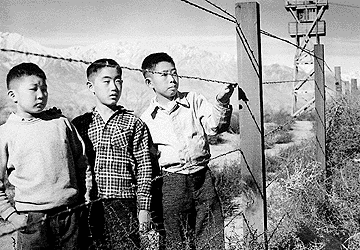
Imagine that one day you received notice that you and your whole family must be ready to move within 48 hours. You could take only the possessions you could carry and no one would tell you when you would be permitted to return home. Sound like a bad dream? This happened to over 100,000 United States citizens and legal residents during World War II. Your job is to find out why." ~ Martha Daly
http://cte.jhu.edu/techacademy/fellows/DALY/webquest/campsrc.htm
On February 19, 1942, President Roosevelt signed an order "Establishing the War Relocation Authority in the Executive Office of the President and Defining its Functions and Duties." Also known as Order 9066, this order started plans of 10 internment camps where more that 110,000 Japanese Americans would be relocated to. Click here to see the document.
Life in Japanese Internment camps was not a pretty picture. When the United States of America decided to take all Japanese-Americans and put them in internment camps, people were taken away from the places, things, and people that they loved in life. These camps were called America's Concentration Camps, and the U.S. did not realize that they were doing the exact same thing as the nazis.
The camps were fenced, and in each fenced camp there were block arrangements. Each block contained 14 barracks, 1 mess hall, and 1 recreational hall on the outside. On the inside was the ironing, laundry, and men and women's lavatories. Other places in the camp included: dry and cold warehouses, a car and equipment repair and storage, an administration, schools, canteens, a library, religious services, hospitals, and a post office.
Anonymous Poem
Circulated at the Poston Camp
THAT DAMNED FENCE
They've sunk the posts deep into the ground
They've strung out wires all the way around.
With machine gun nests just over there,
And sentries and soldiers everywhere.
We're trapped like rats in a wired cage,
To fret and fume with impotent rage;
Yonder whispers the lure of the night,
But that DAMNED FENCE assails our sight.
We seek the softness of the midnight air,
But that DAMNED FENCE in the floodlight glare
Awakens unrest in our nocturnal quest,
And mockingly laughs with vicious jest.
With nowhere to go and nothing to do,
We feed terrible, lonesome, and blue:
That DAMNED FENCE is driving us crazy,
Destroying our youth and making us lazy.
Imprisoned in here for a long, long time,
We know we're punished--though we've committed no crime,
Our thoughts are gloomy and enthusiasm damp,
To be locked up in a concentration camp.
Loyalty we know, and patriotism we feel,
To sacrifice our utmost was our ideal,
To fight for our country, and die, perhaps;
But we're here because we happen to be Japs.
We all love life, and our country best,
Our misfortune to be here in the west,
To keep us penned behind that DAMNED FENCE,
Is someone's notion of NATIONAL DEFENCE!
Poem from University of Arizona Library
The people in the camps had to face other hardships. Many of the camps were located in the desert, and faced unbearable temperatures. The average summer temperatures were over 100 degrees and winter was no better with winter temperatures falling to minus 30 degrees in one of the camps.
Meals in the camps, contained meager portions. Fruit and vegetables were cultivated on the land. They used these to feed the people in the camp. They also used this for commercial consumption. The had livestock that was bred and raised on the land. This was used for food, also.
Sue Tokushige was a young mother of 20, with a 10-day-old baby, when she was sent to a camp in Arizona with her husband. She said the government did not supply milk for her baby. Because she was unable to breastfeed, she fed her daughter only water for 10 days. She recalls with glassy eyes how a doctor told her that, for a person who seemed well-educated, she did not take good care of her baby. 'My daughter still pays for it today, health-wise, for the way our government treated us.'
Some Japanese Americans died in the camps due to inadequate medical care and the emotional stresses they encountered. Several were killed by military guards posted for allegedly resisting orders.
But life did go on in the camps. Children had to be educated, yet the government did not supply teachers. Instead, they looked to the camp members to fill these types of positions and paid them at extremely low wages. If you had two or more years of college you might become an "assistant teacher" who in some cases assumed a full teaching load.
Saturday, March 16, 2013
BERNADETTE DEVLIN
 Bernadette Devlin is one of my heroes. She has been for many years.
 So, to honor the Irish on St. Patrick's Day, here's to Bernadette Devlin
Morgan
----------------------------------------------------------------------------
FROM ABOUT.COM WOMEN'S HISTORY
http://womenshistory.about.com/od/socialism/p/devlin_bio.htm
Bernadette Devlin, a radical feminist and Catholic activist in Northern Ireland, was a founder of People's Democracy. After one failed attempt to be elected, she became the youngest woman ever elected to Parliament in 1969, running as a socialist.
Devlin was part of the August, 1969, "Battle of the Bogside," which attempted to exclude police from the Catholic section of Bogside. Devlin then traveled to the United States and met with the Secretary General of the United Nations. She was given the keys to the city of New York -- and handed them over to the Black Panther Party. When she returned, she was sentenced to six months for her role in the Bogside battle. She served her term after being reelected to Parliament.
She published her autobiography, The Price of My Soul, in 1969, to show the roots of her activism in the social conditions in which she was raised.
In 1972, Bernadette Devlin assaulted the home secretary, Reginald Maudling, after "Bloody Sunday" when 13 people were killed in Derry when British forces broke up a meeting.
Devlin married Michael McAliskey in 1973, and lost her seat in Parliament in 1974. They were among the founders of the Irish Republican Socialist Party in 1974. Devlin ran unsuccessfully in later years for the European Parliament and the Irish legislature, the Dail Eireann. In 1981, she and her husband were victims of an attempted assassination by the Unionist Ulster Defense Association, despite British Army protection of their home.
In more recent years, Devlin was in the news for her support for gays and lesbians who wanted to march in New York's Saint Patrick's Day Parade. In 1996, her daughter Róisín McAliskey was arrested in Germany in connection with an IRA bombing of a British Army barracks; Devlin protested her pregnant daughter's innocence and demanded her release.
In 2003, she was barred from entering the United States and deported on grounds of posing a "serious threat to the security of the United States," though she had been permitted entry many other times.
Friday, March 15, 2013
MANUEL VALLS
 ROMA ACCUSE FRENCH MINISTER OF RACIAL HATRED
SOURCE: TANJUG
FROM B92
http://www.b92.net/eng/news/world-article.php?yyyy=2013&mm=03&dd=15&nav_id=85192
PHOTO Accused of racism: Manuel Valls (Beta/AP, file)
PARIS --
The Roma living in France say they wish to initiate legal action against Interior Minister Interior Manuel Valls, and accuse him of inciting racial hatred.
They resolved to this step because the minister promised to continue a controversial program of dismantling of illegal Roma camps.
The announcement came after Valls was quoted as telling right-wing newspaper Le Figaro that 20,000 Roma immigrants from Bulgaria and Romania are not interested in integrating into the French society.
According to the minister, this is the case "because of cultural reasons, or because they are part of networks of beggars or prostitution."
Activist group Roma Voice pointed out that the comments were a "pack of lies" aimed at erasing the entire Roma community, AFP reported.
"This interview is a very bad sign," the organization said in a statement, adding that it signaled a tougher policy than the one established in 2003.
The group also announced that it would report Valls' comments to the European Union, which is constantly reviewing the legality of the French policy of systematic dismantling of illegal Roma camps and their return to Bulgaria and Romania.
Last year nearly 12,000 Roma were evicted from camps across France.
Tuesday, March 12, 2013
ROMA COMMUNITY CENTER, TORONTO

MUSIC FUNDRAISER IN SUPPORT OF TORONTO'S ROMA COMMUNITY CENTRE
We would like to invite you to attend a music fundraiser to support the work we are doing to help the Roma community. Our goal is to raise $6,000 to cover our fundraising expenses, organize an International Roma Day Celebration in April, and to provide a small salary for our one full-time office staff member.
• Date: Wednesday, March 13, 2013
• Time: 7:00 - 11:30 PM*
• Location: Lula Lounge – located at 1585 Dundas St. W. (near Dufferin).
• Admission: $25.00 – RCC Members $12.00
Enjoy the outstanding music of four Romani bands:
• The Gypsy Rebels
• Julius Csoka & Robert Lakatos
• Romani Rota
• UngroDrom
At 8:00 PM there will be an Silent Art Auction of paintings by Romani artists.
*Doors open at 6:00 PM for those who would like to have dinner
– call Lula Lounge (416) 588-0307 for reservations.
We really hope that you will be able to join us to enjoy some fabulous music, perhaps purchase a one-of-a-kind painting, and help strengthen the capacity of the Roma Community Centre.
— Gina Csanyi-Robah and the Roma Community Centre Board of Directors
www.romatoronto.org
------------------------------------------------------------------------------------------------
This is a wonderful group. I'm amazed by the work they do. They seem tireless.
If anyone can support them, please do.
Morgan
Monday, March 11, 2013
SPAM
 If any of you spammers haven't noticed, I'll say it once again.
 I will not publish any anonymous messages anymore, especially those whose comments are totally irrelevant to the post and especially if they have a business website at the end.
These posts always end, and please visit my website..........

Friday, March 8, 2013
GUATEMALA
 FROM FREEDOM SOCIALIST PARTY
No Good Deed Goes Unpunished in Guatemala
Tecpán, Guatemala, February 2013
By Alfredo Zarazúa, Guatemala City
Sandra Paredes Rojas, organizer of the Joranda Médica Internacional in Tecpán,
Guatemala, is a Guatemalan health care worker who brought a group of North American
doctors through Helps International to the Centro de Urgencias Médicas, the clinic where she has worked for many years. For her selfless labor, the newly appointed clinic director, Miguel Ángel Calel, banned her from working on the event she had spent a month and a half organizing through her international contacts and which she had
planned and executed in years past.
Director Calel had never met Ms. Paredes Rojas but that did not stop him from deciding that she was an abrasive woman because she tends to say things the way they are. He branded her a troublemaker--which is not surprising coming from one who was recently given his new job by the patriarchal and fascist-like Guatemalan government bureaucracy.
Sr. Calel was appointed Director of the Centro de Urgencias Médicas one year ago
by the rightwing, heavy-handed party in power in Guatemala. Apparently, being the
organizer of an event for the poor and indigenous people of Tecpán and environs was
reason enough for Ms. Paredes Rojas to be treated with vicious discrimination and
machismo by Sr. Calel. It is further proof of the poor treatment that health workers,
especially women, are subject to in Guatemala, where reprisals from official party
bureaucrats is common.
Guerry Hoddersen, speaking on behalf of the Freedom Socialist Party (FSP) in the US,
called on Director Calel and the Guatemalan government to open the doors of the clinic
to Ms. Paredes Rojas and held them responsible for threats of violence or intimidation
against her. “No worker, whether he or she is a volunteer or not, should be mistreated
for organizing an event to serve the local indigenous people,” she said, “especially an
event that helps them to be healthy and able to live and work with dignity.”
_____________________________________________
From February 10-17, Ms. Paredes Rojas organized the International Medical Program
2013, which served patients from Totonicapán, San Marcos, Chichicastenango, Sololá
and Sacatepéquez.
This is the second year that she has organized the International Medical Program for the
Centro de Urgencias Médicas in Tecpán. In February 2012, Ms. Paredes Rojas put on a
similar International Medical Program at the same clinic with the help of her international
contacts.
During the 2012 event, Ms. Paredes Rojas was responsible for doing laundry at the
local Centro de Urgencia Médicas. Her work during the full duration of the International
Medical Program was to wash hospital linens for patients that had surgery for hernias,
gall bladders, breast cysts, harelips, split palates, clubfeet, bunions and hysterectomies,
among others. Her shift started at 7:00am and did not end until midnight. She had to
wash laundry by hand since the machines could not wash all the linens used for 60
surgeries per day. (The doctors had thought to bring medical supplies and equipment
but not washing machines for their visit!)
This year medical services were offered in general medicine, pediatrics, gynecology
and dental work. There were so many patients that it was impossible to accommodate
everyone, so requests for hernia and gall bladder surgeries were denied and no help
was available for the many people with strabismus (weakness in eye muscles or crossed
eyes).
When the Clinic Director denied Ms. Paredes Rojas access to the event she had
organized, she set up an “office” outside the clinic where she saw patients, registered
them, and gave them a number for a medical consultation with the international
specialists.
All of Ms. Paredes Rojas’ work is on a volunteer basis and fortunately, the international
specialists supported her, even sharing their food with her. These North American
workers acknowledge that she is the organizer for the Helps International event, whose
purpose is to create an orderly program to assist the legions of people in desperate need
of medical attention. She plays an important role by answering questions posed by the
local people day and night. The doctors know that not just anyone can do that!
Ms. Paredes Rojas’ efforts have borne fruit thanks to the support from the Casa de
la Cultura in Chimaltenango and Tecpán whose members protect her 24 hours a day
so she can remain safe. Otherwise, she could become one more victim of the police
state regime. (If this were to happen, the FSP would mount a public campaign to alert
the medical volunteers and the US government to this abuse of power by the Perez
government.)
Ms. Paredes Rojas was interviewed by a Mexican news outlet and asked how much
she had spent on publicizing this event. She replied she did not spend one penny
because she asked “chimalteco” journalists at the Casa de la Cultura in Chimaltenango
for support. One day they all got together and she was interviewed, thus creating free
publicity for the program. She also visited “chimalteco” radio stations and community
radio in Tecpán to get the word out.
In spite of adversity, Ms. Paredes Rojas is deeply thankful to the volunteer doctors for
coming to this community on the Guatemalan high plateau and expressed her gratitude
to the people that attended the event. She also thanked the Freedom Socialist Party for
donating towels, sheets and pillow cases for hospital beds which the clinic desperately
needed. In February, a member of the FSP visited Ms. Paredes Rojas to show solidarity
with her work and gave her encouraging words to help her face the difficulties brought
on by the rightwing, heartless, self-serving Guatemalan regime.
As she pointed out, the only thing the current regime intends to do regarding health care
is to provide its sympathizers with jobs, even though they do not have the necessary
training to work at a medical facility. This can be seen at the Centro de Urgencias
Médicas in Tecpán where the new director has fired 150 workers and put 100 new ones
in their place. These new workers are not familiar with the correct medical practices
necessary to provide quality care for patients at the Centro de Urgencias Médicas
because they lack the necessary experience.
INTERNATIONAL WOMEN'S DAY
 FROM EUROPEAN ROMA INFORMATION OFFICE
Press Release
It’s time to address the increasing gender inequality faced by Roma women and ensure their active participation in society
8 March 2013
On the International Women’s Day ERIO and Drom Kotar Mestipen call for a focus on the position of Roma women as they suffer from multiple discriminations and social exclusion, both as women and as members of the Roma community. Their lack of education1 due to school absenteeism, segregated schooling, low expectations and racism towards Roma children and the non-inclusion of the Roma culture and contributions in school curricula are some of the factors causing Roma women to be socially and economically excluded and deprived of future employment opportunities.
As the EU Framework for National Roma Integration Strategies up to 2020 states, there is a need to strengthen links with communities, churches and associations through active participation of Roma parents, to improve the intercultural competences of teachers, to reduce segregation and to ensure compliance with the duty to primary school attendance.
Ivan Ivanov, ERIO’s Executive Director notes that “the low educational level of many Roma women is one of the main factors for their social exclusion and poverty. Education is an effective tool to empower Roma women, promote their economic development and active participation in society.
This should be coupled with actions to tackle anti-Roma discrimination to have an effect on the diminished opportunities and poverty that Roma women face”.
Roma women face an increased risk of poverty. We call on the European Commission to ensure that member states implement sufficient measures to address the problems faced by Roma women. We also call on member states to ensure the participation of Roma women in the implementation and monitoring of the National Roma Integration Strategies.
Ana Contreras Fernandez, President of Romani Association of Women Drom Kotar Mestipen states that “In the last years, despite the multiples inequalities we encountered, Romani women have created associations, have actively participated in seminars and conferences where we have claimed our rights and made our voices heard which are many times silenced. Roma are changing mainly thanks to Romani women (grandmothers, mothers and daughters) who have taken a step forward, without leaving aside their most rooted customs, in order to vindicate our most basic rights as full citizens with differences to be respected and dreams to be fulfilled: the dream that our children live in equal terms as the rest of society. It is the responsibility of all of us that this dream becomes a reality.”
Thursday, March 7, 2013
MONK CONFERENCE IN TORONTO
 THIS IS IN RESPONSE TO A CONFERENCE TO BE HELD IN TORONTO.
 AGAIN, A CONFERENCE ABOUT ROMANI WITHOUT ROMANI.
THANK YOU MY FRIENDS AT THE ROMA COMMUNITY CENTER IN TORONTO
MORGAN
------------------------------------------------------
“Nothing About Us Without Us”
“Khanchi Pa Amende Bi-amengo”
Dear Ms Klein:
We are writing to you as supporters, members and members of the Board of Directors of Roma Community Centre, Toronto. As an active and highly-regarded organization at the forefront of the Romani human rights struggle in Canada, RCC is usually contacted or consulted when organizations and institutions plan to hold events about our people. We were therefore surprised to discover – not from conference planners, but from a third party – that a conference on Roma was being organized at the Munk School for Global Affairs. Even though RCC volunteer, Professor Cynthia Levine-Rasky contacted you, offering assistance and a list of prominent Romani academics/ activists as speakers, we had no response to our suggestions.
It is not unusual – but highly egregious – that Roma have been, and continue to be, interpreted and studied by outsiders without our active participation. Although the grad students at Munk School may have had the best of intentions, it is unfortunate that they did not understand the seriousness of excluding the very people about whom they were planning to present (and represent).
Any work with a vulnerable group or one positioned differently in relation to the academics must be done collaboratively: the grad students should have taken the initiative to approach Executive Director Gina Csanyi-Robah and RCC at the outset, inviting her to help shape the program in order to ensure the kind of inclusion that is consistent with social justice principles. The Tri-Council Policy Statement for Research Involving Human Subjects calls this process 'community engagement' when it comes to working with Aboriginal groups to whom one could argue that a refugee group may be compared. Even if this policy may not strictly apply to organization of conferences, the principle is nonetheless essential in dealing with those who have systemically been under-represented and marginalized. The grad students should have consulted with Ms Csanyi-Robah about the program, asking her how she wanted to be integrated into it rather than imposing that on her, at the end, in a limited role. Imposing her role on her is inconsistent with the principles of equity and power-sharing in the spirit of social justice work.
The exclusion of Roma participants seems to be linked to the decision “to keep to an academic focus” (from a letter by Ms Jenna Hay to Gina Csanyi-Robah). Roma and the groves of academe are not mutually exclusive. As you know, we have academics in many fields, some of whom have been excluded from the conference. In her letter to Ms Csanyi-Robah, Ms Hay continued: “the organizers are committed to the original vision …… that is primarily focused on the Roma in Europe” without learning that many of our academics share this focus, and from a Romani perspective. In fact, the Roma academic perspective is critical to the three areas outlined in your call for papers. (Romani scholar Dr. Ethel Brooks presented in January at the UN on the Roma Holocaust – culminating years of persistent effort by Roma to have a Romani speaker included for the first time.)
We fail to see how the inclusion of Roma would in any way interfere with students’ work in the conference’s organization and goals. Indeed, they could have gained valuable experience and insights from RCC. Clearly the organizers did not heed Cynthia Levine-Rasky’s point in her September 25th letter that “it would be unfortunate if there were to be yet another conference about a group of people (be they Indigenous, refugees, Roma, or other groups) who were excluded from the discussion.”
It is imperative that any conference in which a marginalized and persecuted ethnic group is discussed or studied must have fair consultation and representation (especially when a representative body already organized by this group actually and actively exists). Under whose guidance was it deemed fit to exclude us? For too long we have been studied, written about, filmed, and discussed; for too long we have been isolated from academic discourse, and your conference is continuing this practice. In your intention to study Roma as “Europe’s Outsiders: The Persecution, Isolation, and Integration of the Roma (1945–the Present)” you have unfortunately cast Roma in a similar position here in Canada: we have been relegated to the margins, excluded, isolated, and have been made the outsiders – once again – at this conference.
Sincerely,
Roma Community Centre Board of Directors
Michael T. Butch President, Roma Community Centre
Ronald Lee
Vice President, Roma Community Centre
Former Instructor
The Romani Diaspora in Canada
NEW 343 H1S, 2003-2008
New College
University of Toronto
Jen Plyler Danch
Secretary, Roma Community Centre
Kole Kilibarda
Caitlin Hewitt-White
DAVID s Beleznay
Amarna Moscote
Michael Griesz
RCC Executive Director
Gina Csanyi-Robah
RCC Supporters and Members
Ian Hancock, Ph.D.
Professor of Linguistics
Department of Linguistics
College of Liberal Arts
University of Texas at Austin
Romani Archives and Documentation Centre
Debbie Folaron
Associate Professor
Translation Studies
Concordia University, Montreal, Canada
Arielle Dylan, PhD
Assistant Professor
School of Social Work
St. Thomas University
Fredericton, New Brunswick, Canada
E3B 5G3
Cynthia Levine-Rasky, PhD
Associate Professor
Department of Sociology
Mackintosh-Corry Hall
Queen's University
Kingston, Ontario
Canada K7L 3N6
Ethel Brooks
Director of Undergraduate Studies
Department of Women's and Gender Studies
Associate Professor
Departments of Women's and Gender Studies and Sociology
Rutgers University
162 Ryders Lane
New Brunswick, NJ 08901
USA
William L. Bila
Former Vice President, Roma Community Centre
Paris, France
Lynn Hutchinson Lee
Multidisciplinary artist, co-founder of chirikli collective
Chair, RCC Social Justice Committee
Toronto, Ontario
-------------------------------------------------------------------------------------
and many others.
Morgan
__._,_.___
Subscribe to:
Posts (Atom)